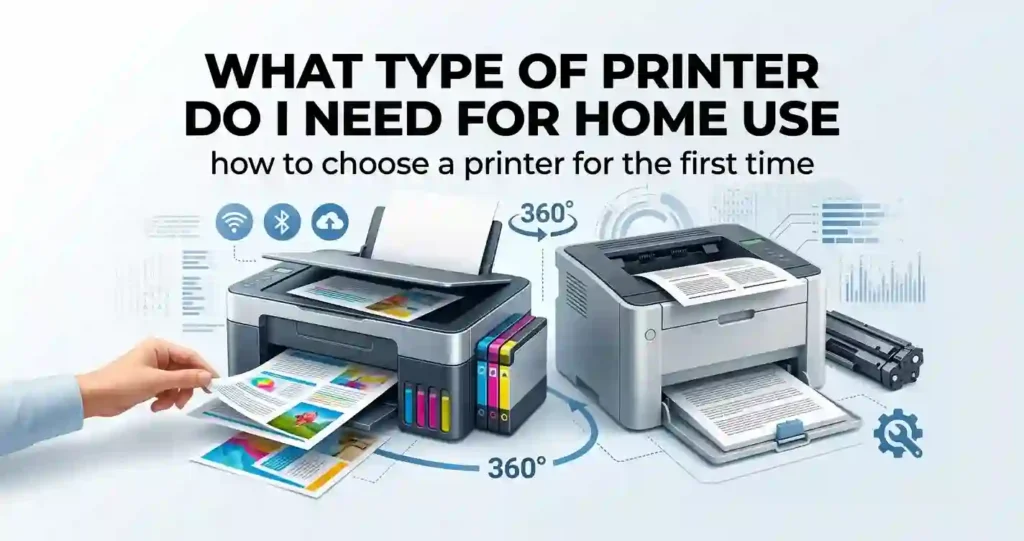

Whether you are setting up a home office, outfitting a small business, or trying to avoid overpriced replacement supplies for family printing, choosing a printer can feel overwhelming. The fundamental decision comes down to two main inkjet designs: standard ink cartridge printers and refillable ink tank printers.
While both use liquid ink to deposit text and images onto paper, their underlying economic models are completely different. Cartridge models are cheap up front but rely on expensive, low-capacity replacement pods. Tank models cost more initial outlay but store bulk liquid ink in high-capacity reservoirs, slashing long-term running costs.
Understanding the differences between an ink cartridge printer vs refillable tank printer determines what you pay at checkout, how often you buy supplies, and your overall total cost of ownership (TCO).
Ink Cartridge Printer vs Refillable Tank Printer: Quick Comparison
Ink cartridge printers use small, plastic, throw-away cartridges that house both ink and (sometimes) integrated printheads. Refillable tank printers (such as Epson EcoTank, Canon MegaTank, HP Smart Tank, and Brother Investment Tank/Refill Tank) use permanent internal ink reservoirs fed by low-cost ink bottles.
- Purchase Price: Cartridge printers have a significantly lower initial cost ($50–$150), whereas tank printers command a higher upfront price ($200–$500+).
- Ink Costs & Page Yield: Cartridge systems yield roughly 200–500 pages per set at $0.08–$0.20 per page. Tank systems yield 6,000–8,000 pages per bottle set at $0.003–$0.01 per page.
- Print Quality & Features: Quality for everyday documents and photos is comparable across both designs. Modern models in both categories feature standard connectivity like Wi-Fi, USB, Apple AirPrint, and mobile app printing.
Quick Comparison Table
| Feature / Metric | Ink Cartridge Printer | Refillable Tank Printer |
| Upfront Hardware Cost | Low ($50 – $150) | Moderate to High ($200 – $500+) |
| Ink Replacement Cost | High ($30 – $80+ per set) | Low ($30 – $60 for high-capacity bottle sets) |
| Black & White Page Yield | ~150 to 500 pages | ~6,000 to 7,500 pages |
| Colour Page Yield | ~100 to 450 pages | ~5,000 to 6,000 pages |
| Cost Per Page (Black) | 5¢ – 10¢ per page | 0.3¢ – 0.5¢ per page |
| Cost Per Page (Colour) | 12¢ – 25¢+ per page | 0.8¢ – 2¢ per page |
| Refill Convenience | Snap-in, mess-free replacement | Bottle squeeze/pour into visible tanks |
| Recommended Print Volume | Under 100 pages per month | 200 to 1,000+ pages per month |
| Risk of Ink Drying Out | Moderate (resolved by changing cartridge) | High (requires routine cleaning/printing) |
| Best For | Low-volume, occasional printing | Home offices, small businesses, high volume |
What Is an Ink Cartridge Printer?
An ink cartridge printer is a traditional inkjet system that uses removable, pre-filled plastic cartridges to deliver liquid ink. These cartridges snap into place inside the carriage assembly.
Standard Cartridge Setup:
[ Cyan Cartridge ] + [ Magenta Cartridge ] + [ Yellow Cartridge ] + [ Black Cartridge ]
                                    ↓
                       [ Carriage / Printhead Unit ]
                                    ↓
                       [ Micro-Droplets onto Paper ]
Most consumer models use either:
- Individual Color Cartridges: Separate pods for Black (K), Cyan (C), Magenta (M), and Yellow (Y).
- Tri-Color Cartridges: A single plastic block containing C, M, and Y chambers. If one color runs out, the entire block must be replaced.
Manufacturers offer standard yield and high-yield (XL/XXL) cartridges. XL options cost more initially but offer lower per-page costs.
How Ink Cartridge Printers Work
Inkjet printheads use micro-resistors to heat liquid ink until it vaporizes, forming a bubble that propels tiny droplets through microscopic nozzles onto the page. Printhead resolution is measured in dots per inch (DPI)—higher DPI yields crisp text and detailed photos.
Most cartridge units sold at retailers like Amazon, Best Buy, or Staples come loaded with home office features:
- Wireless Printing: Dual-band Wi-Fi, Direct Wi-Fi connection, and Bluetooth pairing.
- Mobile Support: Apple AirPrint, Mopria, and vendor-specific mobile apps.
- Duplexing: Automatic two-sided printing to save paper.
What Is a Refillable Tank Printer?
A refillable ink tank printer (or continuous ink supply system) replaces disposable cartridges with high-capacity, permanent ink reservoirs built directly into the housing.
Refillable Tank Setup:
[ Squeeze Ink Bottle ] ──(Keyed Valve)──> [ Permanent Built-in Tank ]
                                                    ↓
                                         [ Continuous Ink Tubing ]
                                                    ↓
                                         [ Dedicated Printhead ]
Users top off these reservoirs by pouring ink from keyed, leak-proof bottles into color-coded slots (CMYK). Because these tanks hold large liquid volumes, you can print thousands of pages before needing another bottle set.
How Refillable Ink Tank Printers Work
- Storage: Liquid ink sits in transparent reservoirs at the front or side of the unit, letting you check fluid levels visually.
- Feeding: Flexible silicone tubes transport ink from the static tanks directly to the moving printhead assembly.
- Refilling: Bottle tops feature unique mechanical keying. The Cyan bottle only fits the Cyan tank opening, eliminating color contamination and spills.
Ink Cartridge vs Refillable Tank: Key Differences
TOTAL COST OVER TIME (Estimates based on ~300 pages/month over 3 years)

Cartridge Printer:
[ Hardware: $80 ] + [ Ink Replacement: $540 ] ───────────────────> Total: $620

Refillable Tank Printer:
[ Hardware: $250 ] + [ Ink Included / Refills: $35 ] ─────────────> Total: $285
Upfront Printer Cost
- Cartridge Printers: Available for $50 to $125. Manufacturers sell the hardware near or below production cost, intending to make long-term profits on ink sales.
- Tank Printers: Usually start around $200 to $350 for entry-level models, going up to $600+ for office-grade units. You are paying for the hardware upfront, while the ink itself is sold with minimal markup.
Ink Cost and Cost Per Page (CPP)
To calculate cost per page:
$$\text{Cost Per Page} = \frac{\text{Price of Ink Cartridges or Bottles}}{\text{Advertised Page Yield}}$$
- Cartridge CPP: A standard $35 black/color cartridge set yielding 200 pages results in an average cost of $0.175 per page.
- Tank CPP: A $30 set of bottle refills yielding 6,000 pages results in an average cost of $0.005 per page.
If you print 250 pages a month, a tank printer repays its higher purchase price within 12 to 18 months.
Page Yield and Printing Volume
Page yields are calculated using standardized ISO/IEC 24712 test pages, which cover roughly 5% of a sheet in ink.
- Cartridges: Standard cartridges print 150–200 pages; XL cartridges print 300–500 pages. High-coverage printing (like full-page color photos) will exhaust them even faster.
- Tanks: Full ink tanks typically yield 6,000 to 7,500 black pages and up to 6,000 color pages out of the box.
Print Quality
Print quality is primarily determined by printhead construction, ink formulas, and paper selection—not whether ink comes from a cartridge or a tank.
- Document Text: Pigment-based black ink in both printer types delivers sharp, smudge-resistant text for business documents.
- Photos & Graphics: Dye-based color inks in standard tank and cartridge models generate vibrant graphics on glossy paper. Specialty photo printers in both categories utilize 6 to 8 color channels for smooth gradations.
Maintenance and Reliability
- Cartridge Replacement: Quick and clean. If a cartridge with an integrated printhead clogs permanently, replacing the cartridge installs a fresh printhead.
- Tank Maintenance: Simple, clean bottle locks prevent spills during refills. However, because tank printheads are permanent, letting a tank sit idle for months can dry out ink in the feeding tubes, requiring ink-purging utility cycles.
Advantages of Ink Cartridge Printers
- Low Initial Outlay: Entry prices under $100 make them accessible for tight budgets.
- Mess-Free Handling: Sealed cartridges click in and out without liquid handling.
- Built-in Refresh: Models with integrated printheads update the primary printing mechanism every time you swap cartridges.
- Compact Footprint: Ideal for dorm rooms, home desks, or small alcoves.
When Cartridge Printers Make Sense
Cartridge printers work best for low-volume users printing fewer than 50 pages per month. If you only print occasional return labels, boarding passes, or school forms, paying more upfront for a tank printer isn’t necessary.
Advantages of Refillable Tank Printers
- Unmatched Running Costs: Cuts ongoing ink costs by up to 80%–90%.
- Massive Out-of-Box Yield: Included ink bottles often last typical users up to two years without buying replacements.
- Visual Ink Monitoring: Clear windows show exact ink levels at a glance.
- Eco-Friendly Design: Significantly reduces single-use plastic waste compared to standard cartridges.
When a Tank Printer Makes Sense
Tank printers are ideal for moderate to high-volume users printing over 150–200 pages per month. They excel in home offices, small businesses, classrooms, and families with frequent school projects.
Disadvantages of Ink Cartridge Printers
- High Long-Term Cost: Frequent cartridge replacements rapidly overtake the original purchase price.
- Low Capacity: Small reservoirs run out quickly during mid-sized print jobs.
- Color Waste: Tri-color cartridges force you to throw out remaining ink if just one color runs dry.
- Digital Locks: Firmware updates can block compatible third-party cartridges, requiring pricier original equipment manufacturer (OEM) replacements.
Disadvantages of Refillable Tank Printers
- High Upfront Cost: Expect to invest at least $200–$300 initially.
- Drying Risk: Inactive printers can develop dried ink clogs in the internal tubes, requiring cleaning cycles that use up ink.
- Slower Base Speeds: Budget tank printers sometimes have lower pages-per-minute (PPM) speeds than similarly priced cartridge models.
Which Printer Is Cheaper Over Time?
To calculate the true value of a printer, look beyond the price tag at checkout and compute the Total Cost of Ownership (TCO):
$$\text{Total Cost of Ownership} = \text{Hardware Purchase Price} + (\text{Monthly Pages printed} \times \text{Cost Per Page} \times \text{Months Owned})$$
Simple Break-Even Calculation
$$\text{Break-Even Point (Pages)} = \frac{\text{Price Difference Between Printers}}{\text{Cost Per Page Savings of Tank System}}$$
Example Scenario
- Cartridge Printer: Costs $80 with a combined cost per page of $0.12.
- Tank Printer: Costs $280 with a combined cost per page of $0.01.
- Price Difference: $200
- Savings Per Page: $0.11
$$\text{Break-Even Point} = \frac{\$200}{\$0.11/\text{page}} \approx \mathbf{1,818\text{ pages}}$$
- If you print 50 pages/month: It takes ~36 months to reach break-even.
- If you print 200 pages/month: It takes ~9 months to reach break-even.
- If you print 500 pages/month: It takes under 4 months to reach break-even.
Which Printer Is Better for Home Use?
                    HOME PRINTING DECISION
                              │
               How many pages do you print?
                              │
         ┌────────────────────┴────────────────────┐
         ▼                                         ▼
  Under 50 pages/mo                       150+ pages/mo
  (Infrequent/Basic)                    (Frequent/Family)
         │                                         │
  [ Cartridge Printer ]                    [ Refillable Tank ]
  - Low upfront cost                      - Near-zero per-page cost
  - Compact size                          - No frequent ink runs
  - Clean replacement                     - Clear ink visual windows
For general household use, match the printer to your routine:
- Occasional Printing: A compact cartridge printer fits tight spaces and low budgets. Just run a test page every few weeks to keep the nozzles clear.
- Busy Households & Students: If multiple family members regularly print assignments, recipes, and color projects, a refillable tank printer will prevent constant ink runs.
Which Printer Is Better for a Home Office or Small Business?
Home offices and small businesses prioritize reliability, duty cycle, and low operating costs:
- Refillable Tank Printers: The clear winner for volume. Features to look for include an Automatic Document Feeder (ADF) for multi-page scanning, Ethernet/Wi-Fi, auto-duplexing, and higher page-per-minute (PPM) ratings.
- Cartridge Printers: Best restricted to remote work setups where document printing is rare and digital workflows dominate.
How to Choose Between an Ink Cartridge and Tank Printer
                               Decision Checklist
                                       │
            ┌──────────────────────────┴──────────────────────────┐
            ▼                                                     ▼
 Choose AN INK CARTRIDGE Printer If:                 Choose A REFILLABLE TANK Printer If:
 • Print < 50 pages per month                        • Print 150+ pages per month
 • Want to spend < $100 upfront                      • Willing to invest $200+ upfront
 • Prefer simple, snap-in cartridge swaps            • Want lower long-term running costs
 • Have limited desk space                           • Want to visually monitor ink levels
Choose an Ink Cartridge Printer If:
- You print fewer than 50 pages per month.
- You want an entry-level purchase under $100.
- You prefer quick, snap-in cartridge changes without handling ink bottles.
Choose a Refillable Tank Printer If:
- You print 150+ pages per month or print in large bursts.
- You want to keep ongoing per-page printing costs as low as possible.
- You want high ink capacity so you don’t have to replace supplies constantly.
Common Buying Mistakes
- Buying strictly on hardware price: Choosing a $45 printer can lead to spending hundreds on ink over the next two years.
- Ignoring page yields: Comparing cartridge prices without checking total page capacity leads to inaccurate cost estimates.
- Buying high volume for light use: Leaving a high-capacity tank printer unused for months can dry out ink lines and cause printhead clogs.
Frequently Asked Questions
Is a refillable tank printer better than an ink cartridge printer?
It depends on volume. For high-volume printing, tank printers offer vastly superior savings and convenience. For rare, low-volume use, cartridge printers offer a much lower entry price.
Are refillable ink tank printers cheaper to run?
Yes. Tank printers deliver an average cost per page of under $0.01 for color and text, compared to $0.08–$0.20 per page on standard cartridge printers.
Do ink tank printers have better print quality than cartridge printers?
No. Print quality depends on resolution (DPI), droplet size, printhead tech, ink chemistry (pigment vs. dye), and paper quality. Both designs produce excellent document and photo quality at similar price points.
How long does ink last in a refillable tank printer?
Out of the box, included ink bottle sets typically last between 1 to 2 years for average users, printing thousands of ISO standard pages before requiring a top-off.
Are ink cartridge printers good for occasional printing?
Yes. They have low entry costs and simple cartridge swaps, making them suitable for occasional single-page tasks.
Do refillable tank printers save money for home use?
Yes, provided your home prints regularly (at least 100–150 pages monthly). Below that volume, it takes years to recover the higher initial hardware cost.
What has a higher page yield: cartridges or ink tanks?
Ink tanks offer substantially higher yields. A set of ink bottles produces 6,000–7,500 pages, compared to 150–500 pages for standard ink cartridges.
Which printer is better for high-volume printing?
Refillable ink tank printers are much better suited for high volumes thanks to low cost per page, large ink reservoirs, and fewer supply changes.
Can refillable tank printers dry out?
Yes. Like all inkjet systems, long periods of inactivity can cause ink to dry in printhead nozzles or delivery tubes. Printing a color test page once a week keeps ink flowing smoothly.
How can I calculate which printer will cost less?
Add the printer’s purchase price to your projected ink cost: multiply your estimated monthly page volume by the printer’s cost per page over a 2- to 3-year period.
Conclusion: Which Printer Should You Buy?
The choice between an ink cartridge printer and a refillable tank printer comes down to your printing volume and budget structure:
- Buy an ink cartridge printer if you print infrequently, want to keep initial expenses low, and prioritize quick cartridge swaps.
- Buy a refillable tank printer if you print regularly, want to cut long-term ink costs, and prefer high-yield ink systems.