Finding the right printer for your home can feel surprisingly tricky. Walk into a major US retailer like Best Buy or Staples—or scroll through Amazon—and you will encounter dozens of sleek boxes ranging from $50 to $400+. They all promise sharp prints, fast speeds, and seamless wireless setup, yet their underlying technologies and long-term operating costs vary wildly.
Many buyers make the mistake of picking the cheapest hardware on the shelf, only to discover a few months later that a full set of replacement ink cartridges costs more than the printer itself. Others buy overly complex office machines that take up half a desk for occasional recipe printing.
To avoid buyer’s remorse, you need to match the machine’s engine to your actual household routines. By evaluating your monthly print volume, color requirements, running costs, and physical space before buying, you can choose a reliable home printer that fits both your budget and your lifestyle.
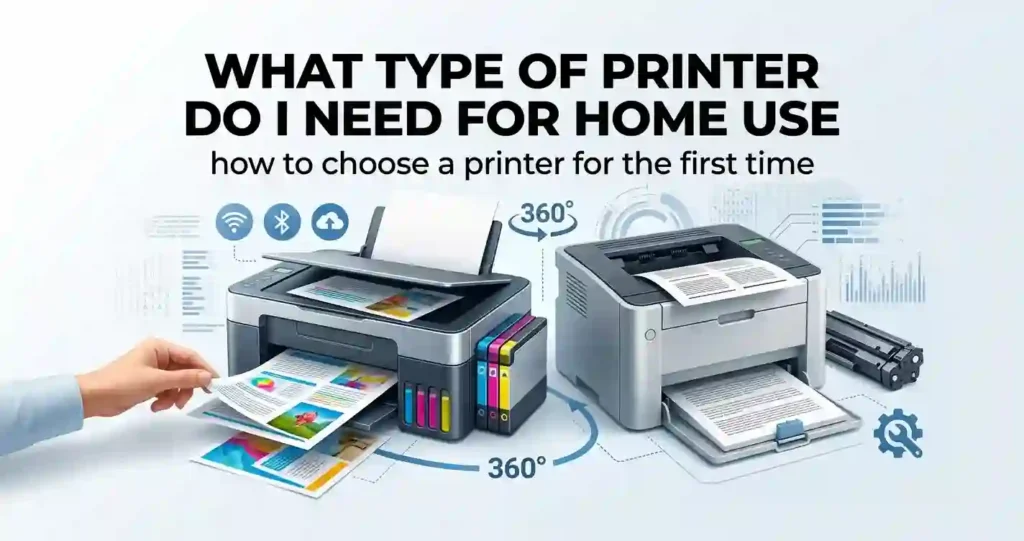
What Type of Printer Do I Need for Home Use?
To choose the right printer for home use, match the underlying technology to what you print and how often you print.
Quick Home Printer Decision Guide:
- Occasional Color & Photo Printing: Choose a traditional Inkjet Printer.
- Frequent Black-and-White Documents: Choose a Monochrome Laser Printer.
- High-Volume Color Printing: Choose a refillable Ink Tank Printer.
- Scanning, Copying, & Remote Work: Choose an All-in-One (AIO) Printer.
                         HOME PRINTER DECISION MATRIX
┌───────────────────────────┬───────────────────────────┬───────────────────────────┐
│ WHAT YOU PRINT            │ PRINT FREQUENCY           │ BEST PRINTER TYPE         │
├───────────────────────────┼───────────────────────────┼───────────────────────────┤
│ Photos, Crafts, Cards     │ Occasional (1-2x/month)   │ Standard Color Inkjet     │
│ Text Forms, Resumes       │ Regular (Weekly)          │ Monochrome Laser          │
│ High-Volume Color/School  │ Heavy (Daily/Weekly)      │ Refillable Ink Tank       │
│ Mixed Papers & Documents  │ Needs Scan / Copy         │ All-in-One (AIO) Inkjet   │
└───────────────────────────┴───────────────────────────┴───────────────────────────┘
Selecting the right device requires evaluating six core factors:
- Printing Volume: The average number of pages your household outputs per month.
- Color Needs: Whether you print exclusively in black-and-white or require full-color printing.
- Print Quality: The level of visual detail needed (e.g., text legibility vs. photo-grade gradients).
- Running Costs: The ongoing price of replacement ink cartridges or toner cartridges.
- Connectivity: How your household devices (laptops, phones, tablets) connect to the hardware.
- Available Space: The physical desktop footprint and tray extension clearance required.
What Will You Use Your Home Printer For?
Every household has unique printing patterns. Identifying your primary document types prevents you from paying for features you do not need or buying hardware that fails under your workload.
Common home printing needs include:
- School Assignments & Worksheets: K-12 homework, essays, study guides, and science fair materials.
- Work Documents & Administrative Forms: Contracts, resumes, tax forms, spreadsheets, and real estate filings.
- Family Photos & Creative Projects: High-gloss photo prints, scrapbooking materials, and holiday cards.
- Daily Household Items: Recipes, event tickets, shipping labels, and craft patterns.
Your printing frequency dictates which hardware category offers the best long-term reliability. Liquid inkjet nozzles can dry out if left idle for several weeks, whereas laser printers use dry toner powder that never dries out.
Before shopping, estimate your realistic monthly page volume. Households printing 20 pages a month require a completely different category of hardware than a remote work home office producing 400 pages a month.
Printing Documents at Home
Text-heavy documents like tax forms, invoices, resumes, and legal papers require crisp, dark lettering that does not smudge under a highlighter.
If your home printing consists almost entirely of text, a monochrome laser printer is typically the most practical choice.
┌─────────────────────────────────────────────────────────────────────────┐
│                      TEXT DOCUMENT CONSIDERATIONS                       │
├───────────────────────────┬─────────────────────────────────────────────┤
│ Print Speed (PPM)         │ 20 to 35 Pages Per Minute for rapid jobs    │
│ Consumable Yield          │ 1,200 to 3,000+ pages per toner cartridge   │
│ Paper Capacity            │ 150 to 250 sheet internal cassette tray     │
│ Duplex Support            │ Automatic double-sided text printing        │
└───────────────────────────┴─────────────────────────────────────────────┘
Monochrome laser printers print at high speeds, feature paper trays that hold up to a full ream of US standard letter paper ($8.5″ \times 11″$), and offer long consumable life.
Printing Photos and Color Documents
Color inkjet printers excel at producing smooth color blends, vibrant graphics, and rich photographic prints.
Key photo and color considerations include:
- Dots Per Inch (DPI): Look for native print resolutions of 2400 x 1200 DPI or higher for detailed photos.
- Color Accuracy: Multi-ink systems (3 to 6 individual color tanks) yield true-to-life skin tones and deeper blacks.
- Borderless Printing: Enables edge-to-edge photo printing without an unwanted white paper margin.
- Specialty Media Support: Compatibility with heavy glossy photo paper, matte cards, and printable label sheets.
Occasional photo printing (a few family snapshots a month) is easily handled by a standard entry-level color inkjet. However, if you plan to print color documents or graphics daily, high-volume color options like ink tank printers are much more economical.
Working or Studying From Home
Remote work and home-schooling environments demand versatile hardware that can process incoming and outgoing physical paperwork.
Essential features for work and study include:
- Wireless & Mobile Printing: Print instantly from laptops, iPhones, Android phones, or iPads via Wi-Fi.
- Integrated Scanner & Copier: Digitizes signed documents, ID cards, and textbook pages.
- Automatic Document Feeder (ADF): A top-mounted tray that automatically pulls multi-page documents through the scanner.
- Automatic Duplexing: Prints on both sides of a page automatically to halve paper usage.
An All-in-One (AIO) printer consolidates these functions into a single device, eliminating the need for separate desktop scanning hardware.
Inkjet vs. Laser Printer for Home Use
Neither inkjet nor laser technology is universally superior; the ideal choice depends on your household’s printing routines.
| Feature | Inkjet Printer | Laser Printer |
| Primary Output | Photos, graphics, mixed media | Text documents, spreadsheets |
| Consumable Type | Liquid ink cartridges or bottles | Dry toner powder cartridge |
| Downtime Risk | Liquid ink can dry out if unused | Toner never dries or spoils |
| Print Speed | Moderate (8–15 PPM) | Rapid (20–40 PPM) |
| Hardware Price | Low to moderate ($50–$250) | Moderate to high ($120–$400) |
| Cost Per Page | Higher with cartridges; ultra-low with tanks | Low to moderate (2¢–4¢ text) |
Choose an Inkjet Printer If You…
- Need to print glossy photographs, vibrant art, or craft projects at home.
- Print a wide variety of media types, including envelopes, cardstock, and photo paper.
- Prefer a lower initial purchase price ($50 to $150) for lighter household needs.
Choose a Laser Printer If You…
- Primarily print black-and-white documents, school papers, and work contracts.
- Print intermittently—going weeks between jobs—and need a machine that works instantly without printhead cleaning cycles.
- Demand sharp text legibility and rapid printing speeds (20+ pages per minute).
Are Ink Tank Printers Good for Home Use?
An ink tank printer replaces traditional micro-cartridges with large, built-in, refillable liquid ink reservoirs. Users pour replacement ink directly from spill-free bottles into designated color tanks on the machine.
       TRADITIONAL CARTRIDGE                     REFILLABLE INK TANK
┌─────────────────────────────────┐       ┌─────────────────────────────────┐
│ Small plastic ink cartridges    │       │ Large internal liquid tanks     │
│ Yield: 150 – 400 pages          │  vs.  │ Yield: 6,000 – 8,000 pages     │
│ Higher cost per page (10¢–15¢+) │       │ Ultra-low cost per page (< 1¢)  │
│ Frequent replacement required   │       │ Refilled with spill-free bottles│
└─────────────────────────────────┘       └─────────────────────────────────┘
Who Should Buy an Ink Tank Printer?
- High-Volume Households: Families with multiple students printing daily homework assignments.
- Home Offices: Businesses printing heavy volumes of color reports, flyers, or invoices.
- Cost-Conscious Users: Anyone willing to pay more upfront ($200 to $400) to secure extremely cheap ink for years.
Who May Not Need an Ink Tank Printer?
- Low-Volume Users: Households printing fewer than 20 to 30 pages per month.
- Strict Budget Shoppers: Buyers who cannot justify spending $200+ on initial hardware.
- Monochrome Document Printers: Anyone who only prints basic text and is better served by a simple $120 black-and-white laser printer.
Do I Need an All-in-One Printer at Home?
An All-in-One (AIO) printer (also known as a multifunction printer) combines printing, flatbed scanning, and digital copying into a single footprint. Some models also include fax functionality.
       ALL-IN-ONE (AIO) PRINTER ENGINE
 ┌──────────────────────────────────────────┐
 │ ┌──────────────────────────────────────┐ │
 │ │ Flatbed Scanner (Single-page scanning)│ │
 │ └──────────────────────────────────────┘ │
 │ ┌──────────────────────────────────────┐ │
 │ │ Auto Document Feeder (Multi-page ADF)│ │
 │ └──────────────────────────────────────┘ │
 │ ┌──────────────────────────────────────┐ │
 │ │ Print Engine (Inkjet or Laser)       │ │
 │ └──────────────────────────────────────┘ │
 └──────────────────────────────────────────┘
Benefits of an All-in-One Printer
- Space Saving: Combines three desktop tools (printer, scanner, copier) into one footprint.
- Document Digitization: Scans signed forms, receipts, tax records, and family photos directly to a laptop or smartphone.
- Quick Copying: Duplicates physical receipts or worksheets at the push of a button without turning on a computer.
When a Single-Function Printer Makes More Sense
Single-function printers only handle printing. They make sense if:
- You already use a smartphone app for scanning documents.
- Desktop space is severely limited.
- You want to allocate your full budget toward a faster, higher-quality print engine rather than extra scanning hardware.
How Much Does It Cost to Run a Home Printer?
The retail price tag on a printer box represents only a portion of its true ownership cost. Ongoing supply expenses—replacement ink, toner cartridges, paper, and occasional maintenance parts—make up the largest share of long-term costs.
  Upfront Hardware Purchase Price
+ (24 Months of Expected Page Volume × Cost Per Page)
+ Paper & Specialty Media Costs
------------------------------------------------------
= True 2-Year Total Cost of Ownership (TCO)
What Is Printer Page Yield?
Page yield is an industry-standard estimate of how many pages a single consumable cartridge or ink bottle can produce before running empty.
Yield ratings are established using standardized testing guidelines set by the International Organization for Standardization (ISO). These tests assume 5% page coverage—roughly equivalent to a short letter with a small logo and double-spaced text.
Typical ISO 5% Page Coverage Area:
┌────────────────────────────────────────┐
│ MEMO: Weekly Schedule                  │
│                                        │
│ Please find the upcoming operational   │
│ timetable below. Contact support if    │
│ you have questions.                    │
│                                        │
│ Thank you,                             │
│ Operations Team                        │
└────────────────────────────────────────┘
If you regularly print dense pages, full-color charts, or photos (which use 30% to 80% page coverage), your real-world page yield will be lower than the rating on the box.
How to Calculate Cost Per Page
To evaluate operating expenses across different models, use the standard Cost Per Page (CPP) formula:
$$\text{Cost Per Page (CPP)} = \frac{\text{Cartridge or Toner Price}}{\text{Page Yield}}$$
Worked Formula Example:
If a replacement black ink cartridge costs $30 and yields 300 pages:
$$\frac{\$30}{300 \text{ pages}} = \$0.10 \text{ per page (10 cents)}$$
If a black toner cartridge costs $60 and yields 3,000 pages:
$$\frac{\$60}{3,000 \text{ pages}} = \$0.02 \text{ per page (2 cents)}$$
Over 3,000 pages, the toner option saves $240 in consumable expenses alone.
What Printer Features Matter Most for Home Use?
Focusing on key specifications prevents you from overpaying for unnecessary commercial capabilities.
┌────────────────────────────────────────┬────────────────────────────────────────┐
│ ESSENTIAL HOME FEATURES                │ OPTIONAL ADVANCED FEATURES             │
├────────────────────────────────────────┼────────────────────────────────────────┤
│ • Wi-Fi / AirPrint / Mobile Support    │ • Automatic Document Feeder (ADF)      │
│ • Automatic Duplex (2-Sided) Printing  │ • Ethernet Port / Cloud Scan           │
│ • Standard Paper Tray (100–250 Sheets) │ • Color Touchscreen Control Panel      │
│ • Readily Available Consumables        │ • Dedicated Photo Paper Tray           │
└────────────────────────────────────────┴────────────────────────────────────────┘
Wi-Fi and Mobile Printing
Wireless connectivity allows every phone, laptop, and tablet in your home to share a single printer without running cable lines.
- Dual-Band Wi-Fi (2.4GHz / 5GHz): Keeps the printer connected across modern home networks.
- Apple AirPrint & Android Mopria: Built-in mobile printing standards that allow instant printing from iOS and Android devices without installing third-party drivers.
- Wi-Fi Direct: Creates a direct wireless link between a smartphone and the printer, useful if your router goes offline.
Automatic Duplex Printing
Automatic duplex printing flips paper internally to print on both sides of the sheet without manual intervention. This feature saves paper, lowers supply costs, and reduces physical document thickness for school reports and work filings.
Print Speed and Paper Capacity
- Pages Per Minute (PPM): Measures output speed. A rating of 10–15 PPM for color and 20–30 PPM for black-and-white is ideal for home environments.
- Input Paper Tray Capacity: Entry-level models offer 50–100 sheet rear feeds, while mid-range models include 150–250 sheet internal paper cassettes. Enclosed paper cassettes protect paper from dust and pet hair.
What Print Quality Do You Need at Home?
Understanding key resolution metrics helps you pick a machine that delivers the visual fidelity your tasks require.
For Text Documents
Text document clarity relies on precise edge contrast rather than maximum resolution color blending.
Standard 600 x 600 DPI output yields sharp, crisp lettering for essays, tax paperwork, and resumes. Monochrome laser printers deliver dark, smudge-proof lettering on standard copy paper without saturating the page.
For Photos and Graphics
Photo printing requires fine dot placement, smooth color blending, and deep black shades.
Look for color inkjet models offering:
- Native resolutions of 1200 x 1200 DPI to 4800 x 1200 DPI.
- Borderless printing modes for standard photo sizes ($4″ \times 6″$, $5″ \times 7″$, $8.5″ \times 11″$).
- Support for heavy glossy photo media (60 lb+ / 230 GSM+).
What Connectivity Options Should a Home Printer Have?
Choosing the right connection interface ensures your printer works smoothly with your household tech.
       CONNECTIVITY TYPES FOR HOME PRINTERS
┌──────────────────────────┬──────────────────────────┐
│ WIRELESS INTERFACES      │ WIRED INTERFACES         │
├──────────────────────────┼──────────────────────────┤
│ • Dual-Band Wi-Fi        │ • USB Type-B / Type-C    │
│ • Wi-Fi Direct           │ • Ethernet (RJ-45)       │
│ • AirPrint / Mopria      │                          │
│ • Bluetooth Setup        │                          │
└──────────────────────────┴──────────────────────────┘
Wireless vs. USB Printing
- Wi-Fi Convenience: Place the printer anywhere in your home within router range. Allows multiple household members to print simultaneously from different rooms.
- USB Direct Connection: A single USB cable connects directly to one PC or Mac. It provides maximum connection stability with zero network configuration, but restricts access to that specific computer.
- Ethernet Connection: Connects directly into a home router or network switch, delivering high-speed stability for home offices.
How to Choose a Printer Based on Monthly Print Volume
Matching your hardware choice to your household volume prevents unexpected breakdowns and excessive operating costs.
                               VOLUME CATEGORIES
┌─────────────────────────────────────────────────────────────────────────────┐
│ Low Volume (< 50 Pages/Month)   --> Compact Laser or Entry-Level Inkjet     │
│ Moderate Volume (50–250 Pages)  --> All-in-One Inkjet or Compact Laser      │
│ High Volume (250+ Pages/Month)  --> Ink Tank System or Business Laser      │
└─────────────────────────────────────────────────────────────────────────────┘
Occasional Home Printing (< 50 Pages/Month)
Households printing only a few pages a month should prioritize a compact size, easy setup, and low hardware cost.
If you print exclusively in black and white, choose a compact monochrome laser printer to prevent dried ink issues during idle periods. If occasional color is needed, choose a low-cost entry-level color inkjet.
Moderate Home Printing (50 to 250 Pages/Month)
Households with students, active remote workers, or busy routines should look for an All-in-One inkjet or mid-range laser printer.
Prioritize automatic duplex printing, an internal 150-sheet paper tray, Wi-Fi connectivity, and high-yield cartridge options to keep cost per page manageable.
High-Volume Home or Home-Office Printing (250+ Pages/Month)
Households printing daily homework stacks, commercial flyers, or extensive work filings should choose a refillable ink tank printer or a high-yield laser printer.
At high print volumes, the low cost per page of ink tank or laser supplies will quickly offset a higher initial hardware price.
Common Mistakes to Avoid When Buying a Home Printer
Avoid these common traps when selecting a home printer:
- Buying purely on the lowest retail price: A $49 printer sale can lead to $60 cartridge replacements every few hundred pages.
- Ignoring usage habits: Buying an inkjet printer when you only print once every two months can lead to clogged printhead nozzles.
- Overbuying enterprise features: Buying a bulky commercial office printer wastes desk space and power.
- Forgetting to check device compatibility: Purchasing a printer without verifying Apple AirPrint or Android Mopria support for your family’s phones.
Other Mistakes to Avoid
- Overlooking paper tray size: Buying a 50-sheet capacity printer for a home office that produces 200 pages a week forces constant paper refilling.
- Ignoring manual duplex limitations: Buying a low-end printer only to realize double-sided printing requires manually flipping and refeeding every sheet.
- Stocking non-returnable supplies: Buying third-party ink cartridges before verifying if printer firmware updates block unchipped supplies.
Quick Home Printer Buying Checklist
Use this checklist to confirm your choices before buying:
- [ ] Determine Color Needs: Decide if black-and-white printing is sufficient or if color printing is necessary.
- [ ] Estimate Monthly Volume: Calculate your expected pages per month (<50, 50–250, or 250+).
- [ ] Select Core Engine: Choose between Inkjet, Laser, Ink Tank, or All-in-One.
- [ ] Calculate Cost Per Page: Divide replacement supply price by cartridge page yield.
- [ ] Confirm Wireless Support: Verify Wi-Fi, Apple AirPrint, and Android Mopria capability.
- [ ] Check Duplex Printing: Confirm the printer supports automatic double-sided printing.
- [ ] Check Scanner Features: Determine if you need a flatbed scanner or an Automatic Document Feeder (ADF).
- [ ] Measure Physical Space: Check printer dimensions against your desk or shelf area.
- [ ] Verify Paper Handling: Confirm support for standard US letter paper and your preferred media weights.
- [ ] Calculate Total Cost of Ownership: Add the hardware price to two years of estimated supply costs.
Which Printer Is Best for Different Home Users?
┌───────────────────┬──────────────────────┬──────────────────────────────────┐
│ USER PROFILE      │ RECOMMENDED CATEGORY │ KEY REASONING                    │
├───────────────────┼──────────────────────┼──────────────────────────────────┤
│ Active Families   │ All-in-One Ink Tank  │ Low cost per page, color craft   │
│ College Students  │ Compact Mono Laser   │ Reliable text, fast, compact     │
│ Remote Workers    │ Laser AIO or Ink Tank│ High volume, scanning, auto-feed │
│ Photo Hobbyists   │ Photo Inkjet         │ Wide color gamut, borderless     │
└───────────────────┴──────────────────────┴──────────────────────────────────┘
Best Printer for Families
Active households with multiple children benefit from an All-in-One Ink Tank printer (like the Epson EcoTank or Canon MegaTank series). These machines handle school papers, color charts, recipes, and crafts at an ultra-low cost per page.
Best Printer for Students
College students needing to output essays and study sheets late at night should pick a compact monochrome laser printer (like the Brother HL-L series) or a compact wireless inkjet. Laser models offer fast text output and zero risk of dried ink during break periods.
Best Printer for Remote Workers
Home office workers managing daily paperwork should choose an All-in-One Laser or Ink Tank Printer with an Automatic Document Feeder (ADF), auto-duplexing, and dual-band Wi-Fi.
Best Printer for Photo Printing at Home
Hobbyists printing detailed photography should select a specialized photo inkjet printer with multi-ink support (5 or 6 individual cartridges), borderless photo printing, and high DPI capabilities.
Frequently Asked Questions About Home Printers
What type of printer is best for home use?
For basic document printing, a monochrome laser printer is typically best because it requires minimal maintenance and toner never dries out. For mixed home use with color needs, an All-in-One Ink Tank printer provides the best balance of features and long-term economy.
Is an inkjet or laser printer better for home use?
A laser printer is better if you print text documents intermittently, because dry toner powder cannot spoil or dry out. An inkjet printer is better if you print photographs, color charts, graphics, or craft media.
Should I get a color or black-and-white printer?
Get a black-and-white (monochrome) laser printer if you only print text forms, shipping labels, tax papers, or essays. Choose a color printer if your household prints school projects, photographs, color spreadsheets, or creative designs.
Is an all-in-one printer worth it for home use?
Yes. All-in-One printers add flatbed scanning and copying capabilities in a single footprint, making it easy to digitize paperwork, signed forms, and receipts.
Are ink tank printers cheaper to run?
Yes. Refillable ink tank printers cost more upfront ($200 to $400), but their bottled ink replacement systems cut page costs to less than 1 cent per color page, delivering substantial long-term savings.
How many pages should a home printer print per month?
There is no single rule, but most home printers are designed to handle 50 to 300 pages per month. Always check the manufacturer’s recommended monthly page volume rather than relying on its peak duty cycle limit.
What does page yield mean on a printer?
Page yield is the estimated total number of pages a single ink or toner cartridge can produce before running empty, measured against industry-standard 5% page coverage.
Do I need Wi-Fi on my home printer?
Wi-Fi is highly recommended for modern home setups. It allows laptops, smartphones, and tablets across your household to share a single printer without needing USB cables.
What printer is cheapest to operate at home?
Monochrome laser printers are cheapest for black-and-white text printing, while refillable ink tank printers are cheapest for high-volume color printing. Both offer significantly lower costs per page than traditional ink cartridge models.
How much should I spend on a home printer?
Plan to spend $100 to $180 for a reliable standalone monochrome laser or entry-level inkjet printer, or $200 to $300 for an All-in-One refillable ink tank printer.
Conclusion: Choosing the Right Printer for Your Home
Choosing the ideal home printer comes down to understanding your household’s printing routines.
Start by estimating your monthly page volume and determining whether you print mostly black-and-white text or require full-color photos and graphics. Weigh the low initial purchase price of standard cartridge inkjets against the low running costs and long-term economy of laser and ink tank systems. Always calculate the Total Cost of Ownership (TCO) using the cost-per-page formula before making your final purchase.
By aligning print technology, paper tray capacity, and wireless connectivity with your actual needs, you will enjoy reliable, hassle-free printing for years to come.
Calculate Your Home Printing Costs Before You Buy
Unsure what your candidate printer will cost to run over time? Perform a simple cost-per-page comparison before checking out at major US retailers like Amazon, Best Buy, or Staples.
Gather the cartridge prices and page yields for your prospective models, calculate the two-year running costs based on your estimated monthly volume, and select the machine that fits your true budget. Estimate your real printing costs today to choose a home printer that stays affordable over time.