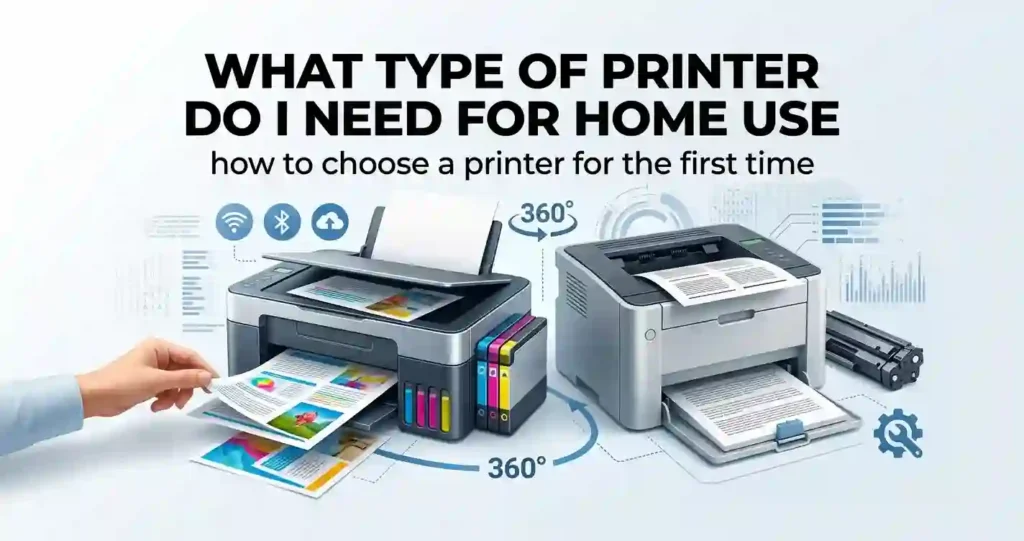
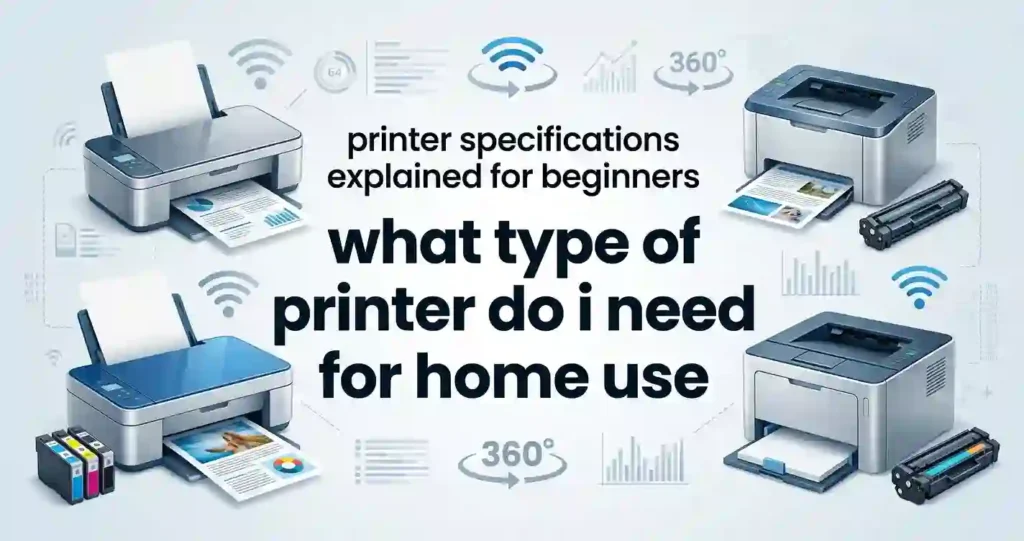
Buying a new printer can feel overwhelming when you are confronted with a wall of technical jargon. Numbers like 4800 x 1200 DPI, 22 PPM, and 15,000-page duty cycles sound impressive, but what do they actually mean for your day-to-day printing?
Printer specifications are simply the standardized measurements and feature descriptions used by manufacturers to define a printer’s capabilities, speed, image output quality, and long-term operating costs.
Understanding these specs helps US home users, students, and small business owners avoid two common, costly mistakes: buying an underpowered device that bogs down your workflow, or overpaying for complex features you will never use.
This guide breaks down essential printer specifications—including DPI, PPM, page yield, duty cycle, connectivity, paper handling, and cost per page (CPP)—so you can make an informed, budget-friendly decision.
What Are Printer Specifications?
Printer specifications are the technical details that describe a device’s hardware limits, operational speeds, print quality, network compatibility, and consumable requirements.
These metrics give you an objective way to compare different brands and models. For instance, comparing an inkjet printer to a laser printer is much easier when you look at standardized measurements for print speed and page yield side-by-side.
+-----------------------------------------------------------------------+
|                       CORE PRINTER SPECIFICATIONS                     |
+--------------------------+--------------------------------------------+
| Print Technology         | Inkjet, Laser, LED, or All-in-One (MFP)    |
+--------------------------+--------------------------------------------+
| Print Speed (PPM)        | Pages Per Minute (Black vs. Color)         |
+--------------------------+--------------------------------------------+
| Print Resolution (DPI)   | Dots Per Inch (Image detail and clarity)   |
+--------------------------+--------------------------------------------+
| Page Yield               | Estimated pages printed per cartridge      |
+--------------------------+--------------------------------------------+
| Running Costs (CPP)      | Cost Per Page (Cartridge Price ÷ Yield)    |
+--------------------------+--------------------------------------------+
| Monthly Duty Cycle       | Maximum vs. Recommended monthly workload   |
+--------------------------+--------------------------------------------+
| Connectivity             | Wi-Fi, Ethernet, USB, AirPrint, Mopria     |
+--------------------------+--------------------------------------------+
Printer Specifications Beginners Should Check
When reading a spec sheet online or on a box at retailers like Best Buy or Staples, focus on these primary categories:
- Print Technology: Inkjet, Laser, LED, or All-in-One multifunction units.
- Performance: Speed (PPM), Resolution (DPI), and Monthly Duty Cycle.
- Capacity: Paper tray size and cartridge page yield.
- Features: Duplexing (two-sided printing), connectivity, and supported media sizes.
Printer Resolution: What Does DPI Mean?
DPI stands for Dots Per Inch. It measures how many individual dots of ink or toner a printer can lay down within a linear one-inch span on a sheet of paper.
In theory, the higher the DPI, the sharper and more detailed the printed image or text will be. A spec listing “1200 x 1200 DPI” means the printer places a grid of 1,200 horizontal dots by 1,200 vertical dots per square inch.
     1 Inch Wide
  +-----------------+
  | . . . . . . . . |  <-- 300 DPI: Fewer, larger dots (Good for basic text)
  | . . . . . . . . |
  | ................|
  | ................|  <-- 1200+ DPI: Dense dot placement (Sharp photos & fine lines)
  +-----------------+
Manufacturers usually list two DPI numbers:
- Black-and-White Resolution: Often lower (e.g., 600 x 600 DPI or 1200 x 1200 DPI), which is more than enough for crisp text documents.
- Color/Photo Resolution: Frequently higher (e.g., 4800 x 1200 DPI), allowing for smooth color gradients and fine details in photo prints.
Featured Snippet Summary: DPI (Dots Per Inch) measures how many individual ink or toner dots a printer places within one inch of paper. While higher DPI can provide greater detail, real-world print quality depends heavily on paper type, ink formulation, and printhead design.
Is Higher DPI Always Better?
Not necessarily. A higher DPI rating does not automatically mean a printer is superior for every daily task.
- Text vs. Photos: Standard black text on US Letter paper looks sharp at 600 x 600 DPI. Extra resolution above this is virtually indistinguishable to the naked eye for word processing documents.
- Resource Usage: Printing at maximum DPI uses significantly more ink or toner and slows down the print engine, taking longer to output every page.
- Media Dependency: High DPI setting on cheap 20 lb copy paper causes the ink to bleed into the paper fibers, ruining the detail. You need specialized photo paper or coated media to benefit from high DPI settings.
Printer Speed: What Does PPM Mean?
PPM stands for Pages Per Minute. This spec indicates how fast a printer outputs completed pages under standard test conditions.
Manufacturers measure PPM using standardized ISO testing protocols (such as ISO/IEC 24734). These tests measure output speeds after the first page has successfully processed and exited the warming phase.
- Black-and-White (Monochrome) PPM: Generally faster because the engine only applies black toner or ink.
- Color PPM: Slower due to the multi-pass process of applying Cyan, Magenta, Yellow, and Black (CMYK) layers.
ADVERTISED PPM (Ideal ISO Test)   vs.   REAL-WORLD SPEED
+------------------------------+       +------------------------------+
| Continuous text printing     |       | First-page-out delay (warmup)|
| Simple layout files          |  -->  | High-resolution images       |
| Standard paper input         |       | Wi-Fi processing latency     |
+------------------------------+       +------------------------------+
How Many PPM Do You Need?
Matching PPM to your typical print workload keeps you from waiting around the output tray without forcing you to buy an expensive commercial unit.
- Occasional Home Use (1–10 PPM): Perfect for printing travel passes, school forms, or recipes once or twice a week.
- Students & Home Offices (10–25 PPM): Ideal for printing class notes, multi-page reports, and tax documents efficiently.
- Small Businesses & Shared Workspaces (25–45+ PPM): Essential for multi-user environments where long queues delay daily operations.
Page Yield Explained: How Many Pages Will Ink or Toner Print?
The estimated total number of pages a single ink or toner cartridge can print before running out.
Page yield measurements follow standard ISO/IEC testing standards, which assume a standard 5% page coverage—roughly equivalent to a short letter or a brief paragraph of text without large graphics or heavy logos.
       5% COVERAGE                     20%+ COVERAGE
  (Standard ISO Test)             (Graphics / Heavy Photos)
+------------------------+      +------------------------+
|  Text text text text   |      | [████████████████████] |
|  text text text text.  |      | [████ Photo Image  ██] |
|                        |      | [████████████████████] |
+------------------------+      +------------------------+
Yields ~100% of rating          Yields 25% - 50% of rating
Standard-Yield vs. High-Yield Cartridges
Manufacturers design different cartridge sizes to fit the same printer model:
Manufacturers design different cartridge sizes to fit the same printer model:
- Standard-Yield: Cheaper upfront cost, contains less ink/toner, best for low-volume users.
- High-Yield (XL): Costs more initially, holds significantly more ink/toner, delivers a lower cost per page.
- Extra High-Yield (XXL): Designed for heavy office printing, yielding thousands of pages per unit.
What Is Cost Per Page?
Cost Per Page (CPP) is the true measure of a printer’s running expenses. Calculate CPP using this formula:
Cost Per Page (CPP)=Estimated Page YieldCartridge Price ($)
If a black ink cartridge costs $30.00 and offers an estimated yield of 600 pages:
CPP=600$30.00=$0.05 (or 5 cents per page)
+------------------+------------------+-----------------+-------------------+
| Cartridge Type   | Cartridge Price  | Rated Yield     | Cost Per Page     |
+------------------+------------------+-----------------+-------------------+
| Standard Ink     | $24.99           | 200 pages       | 12.5 cents        |
| XL High-Yield    | $39.99           | 500 pages       | 8.0 cents         |
| Laser Toner      | $69.99           | 3,000 pages     | 2.3 cents         |
| Ink Tank Refill  | $14.99           | 6,000 pages     | 0.2 cents         |
+------------------+------------------+-----------------+-------------------+
Inkjet vs. Laser Printer Specifications
Choosing between an inkjet and a laser printer comes down to what you print most often and how frequently you print.
   INKJET PRINTER                        LASER PRINTER
+-----------------------+             +-----------------------+
|  Liquid Ink Droplets  |             |  Fused Toner Powder   |
|  Rich Color Photos    |             |  Razor-Sharp Text     |
|  Lower Initial Cost   |             |  Fast Print Speeds    |
|  Higher Cost/Page     |             |  Lower Cost/Page      |
+-----------------------+             +-----------------------+
Inkjet Printer Specs
Inkjet printers spray microscopic liquid ink droplets directly onto paper.
- Strengths: Outstanding photo printing, vibrant color graphics, compact desktop footprint, and low upfront purchase prices (often under $100).
- Consumables: Uses small liquid ink cartridges (CMYK) or refillable ink tanks (EcoTank/Smart Tank).
- Best For: Families, students, and photo enthusiasts printing varied media.
Laser Printer Specs
Laser printers use a static charge, a laser beam, and a heated fuser roller to melt dry toner powder onto paper.
- Strengths: Rapid print speeds (30+ PPM), razor-sharp text, smudge-proof output, and high cartridge yields.
- Consumables: Uses dry toner cartridges and separate drum units.
- Best For: Text-heavy office documents, high-volume workloads, and users who print infrequently (toner powder never dries out or clogs, unlike liquid ink).
Which Printer Type Is Best for You?
+---------------------+-----------------------+-----------------------+
| User Profile        | Recommended Type      | Primary Reason        |
+---------------------+-----------------------+-----------------------+
| Occasional / Family | Inkjet or Ink Tank    | Low upfront cost      |
| College Student     | Monochrome Laser      | Fast, reliable text   |
| Home Office (Docs)  | Monochrome Laser      | Low cost per page     |
| Small Business      | Color Laser / MFP     | High speed & capacity |
+---------------------+-----------------------+-----------------------+
Printer Connectivity Specifications Explained
Modern printers offer multiple ways to send print jobs from computers, smartphones, and tablets across a home or office setup.
       +------------+        (Wi-Fi / Wi-Fi Direct / Bluetooth)
       | Smartphone | ------------------------+
       +------------+                         |
                                              v
+------------+       (Ethernet)        +--------------+
| Router/Net | ----------------------> |   PRINTER    |
+------------+                         +--------------+
                                              ^
       +------------+         (USB)           |
       | Laptop/PC  | ------------------------+
       +------------+
Wi-Fi vs. Ethernet vs. USB
- Wi-Fi (802.11b/g/n/ac): Allows any device on your local wireless network to print without physical cables. Dual-band Wi-Fi (2.4GHz / 5GHz) helps prevent interference issues.
- Ethernet (RJ-45): A physical cable connection to your network router. Provides the most stable connection for shared office printers handling large document queues.
- USB (Type-B or Type-C): A direct wired connection from one computer to the printer. Plug-and-play simplicity, but limits printing to that specific wired computer.
Mobile and Cloud Printing
Look for these mobile features when reviewing specs:
- Apple AirPrint: Native wireless printing for iPhones, iPads, and Macs without installing extra drivers.
- Mopria Print Service: The Android equivalent for seamless wireless printing.
- Wi-Fi Direct: Creates a direct peer-to-peer wireless connection between your phone and printer, bypassing your home router entirely.
Automatic Duplex Printing and Paper Handling
Paper handling specifications determine how many sheets a printer holds and how it processes physical media.
Duplex Printing
Automatic Duplex Printing means the printer automatically flips a sheet of paper over to print on both sides without manual intervention.
SINGLE-SIDED PRINTING                    AUTOMATIC DUPLEX
+-------+     +-------+               +-------+
| Page 1|  +  | Page 2|               | Page 1|  (Printer flips page)
+-------+     +-------+               +---|---|  (Prints Page 2 on back)
  2 Sheets Used                         +-------+  1 Sheet Used
- Saves Money: Reduces paper consumption by up to 50%.
- Professional Look: Creates double-sided booklets, manuals, and reports easily.
Important Paper Handling Specs
- Input Tray Capacity: How many blank sheets the main tray holds (typically 100–250 sheets for home units).
- Supported Paper Sizes: Standard US Letter (8.5×11 inches), US Legal (8.5×14 inches), Executive, and #10 Envelopes.
- ADF (Automatic Document Feeder): A top tray that feeds multi-page documents through the scanner automatically.
Printer Duty Cycle: How Much Can You Print?
The Monthly Duty Cycle is a stress-test metric defining the absolute maximum number of pages a printer hardware engine can physically produce in a month without failing.
Recommended Monthly Volume vs. Maximum Duty Cycle
Never buy a printer based on its maximum duty cycle alone. Instead, compare your printing needs against the Recommended Monthly Page Volume.
+-------------------------------------------------------------------+
|  MAXIMUM DUTY CYCLE: 15,000 Pages/Mo (Stress Limit - Do Not Target)|
|                                                                   |
|  RECOMMENDED VOLUME: 250 - 1,500 Pages/Mo (Ideal Operating Range) |
+-------------------------------------------------------------------+
- Maximum Duty Cycle: Pushing a printer to this limit consistently causes mechanical wear, paper jams, and premature hardware failure.
- Recommended Monthly Page Volume: The ideal operational range designed to keep the printer running reliably for years.
All-in-One Printer Specifications
An All-in-One (AIO) or Multifunction Printer (MFP) combines printing, flatbed scanning, copying, and faxing into a single desktop device.
+------------------------------------------------------------------+
|                    ALL-IN-ONE (MFP) FEATURES                     |
+-------------------+----------------------------------------------+
| Print Engine      | Inkjet or Laser                              |
| Flatbed Scanner   | Optical Resolution (e.g., 1200 x 2400 DPI)   |
| ADF Scanner       | Single-pass vs. Reversing Duplex Scanning    |
| Digital Copying   | Standalone operation without a PC            |
+-------------------+----------------------------------------------+
Scanner Specs to Check
- Optical Resolution: True hardware resolution (e.g., 1200×2400 DPI). Ignore “interpolated” resolution numbers, which rely on software enhancements.
- Color Depth (Bit Depth): 24-bit is standard; 48-bit offers richer color fidelity for photo archival scanning.
- Duplex ADF: Scans both sides of a double-sided document automatically.
Printer Memory, Processor, and Performance
Just like a computer, modern printers rely on an onboard processor (CPU) and memory (RAM) to buffer incoming files, process complex print vector paths, and manage print queues.
Print Job Sent --> [ Printer RAM Buffer ] --> [ CPU Vector Rendering ] --> Physical Output
- Basic Home Printers: Typically feature 64 MB to 256 MB of fixed memory, which handles basic text files and simple PDFs easily.
- Office Printers: Contain 512 MB to 2 GB+ of RAM along with dedicated multi-core processors. Extra memory prevents memory overflow errors when multiple users send large, graphics-heavy PDF files simultaneously.
Printer Size, Weight, and Installation Requirements
Before purchasing a printer, measure your available desk space carefully, keeping physical operational clearances in mind.
       |   18 Inches Top Clearance (Scanner lid open)
       v
+--------------+
|   PRINTER    | ===>  10 Inches Front Clearance
+--------------+       (Paper output tray extended)
- Footprint Dimensions: Width × Depth × Height.
- Operational Clearance: Add 6–10 inches to the depth for fully extended output trays, and at least 10–15 inches above the top for opening flatbed scanner lids or ADF trays.
- Ventilation & Access: Ensure side clearance for power cords, cooling vents, and side door access for clearing paper jams or replacing consumables.
Ink and Toner Specifications Beginners Should Understand
Consumables account for the vast majority of a printer’s total lifetime operating cost.
+------------------+-----------------------+------------------------+
| Consumable Type  | Inkjet Cartridges     | Laser Toner Units      |
+------------------+-----------------------+------------------------+
| Media Material   | Liquid Ink            | Dry Powder             |
| Ink Sub-Type     | Pigment vs. Dye Ink   | Polymerized Resin      |
| Shelf Life       | 18–24 Months          | Indefinite (If dry)    |
| Dry-Out Risk     | High if left unused   | Zero                   |
+------------------+-----------------------+------------------------+
- Dye-based Ink: Delivers vibrant, saturated colors on glossy photo paper, but can smudge if exposed to moisture.
- Pigment-based Ink: Fast-drying, water-resistant, and marker-smudge-proof. Ideal for sharp text documents.
- Original Equipment Manufacturer (OEM): Cartridges built directly by the printer manufacturer (e.g., HP, Canon, Epson, Brother). They offer guaranteed quality, but come at a premium price.
- Compatible/Remanufactured Cartridges: Third-party alternatives that offer lower costs, though print quality and cartridge yield consistency can vary.
How to Read a Printer Specification Sheet
When reading a manufacturer product sheet, skip the marketing claims and focus on this evaluation sequence:
[ Step 1: Technology ]  --> Inkjet vs. Laser (Match to document style)
          |
[ Step 2: Running Cost ]--> Price per cartridge ÷ Yield (Calculate CPP)
          |
[ Step 3: Performance ] --> PPM speed + DPI resolution ratings
          |
[ Step 4: Usability ]   --> Wi-Fi, Automatic Duplex, ADF, Tray size
Quick Printer Specs Checklist
- [ ] Print Technology: Inkjet, Ink Tank, or Laser?
- [ ] Speed (PPM): At least 10 PPM for home; 25+ PPM for offices.
- [ ] Cost Per Page: Under 3¢ for text; under 10¢ for color.
- [ ] Duplex: Is automatic two-sided printing built-in?
- [ ] Connectivity: Dual-band Wi-Fi, Ethernet, AirPrint, Mopria?
- [ ] Paper Capacity: Does the tray hold a full pack of paper?
How to Choose a Printer Based on Your Printing Needs
Best Specs for Occasional Home Printing
If you only print a few pages a month (e.g., shipping labels, boarding passes, or school permission slips):
- Recommended Type: Entry-level Inkjet or Compact Monochrome Laser.
- Key Specs: Compact footprint, simple Wi-Fi setup, low initial purchase price.
- Pro Tip: If you print very rarely, consider an inexpensive monochrome laser printer. Laser toner cartridges never dry out or clog printheads when sitting idle for weeks.
Best Specs for a Home Office
If you work from home and handle daily invoices, client proposals, and scanned documents:
- Recommended Type: All-in-One Ink Tank (e.g., Epson EcoTank) or Color Laser.
- Key Specs: Auto duplex printing, 15–25 PPM, Automatic Document Feeder (ADF), low Cost Per Page (under 2 cents).
Best Specs for Small Businesses
If multiple team members share a central printer for high-volume document production:
- Recommended Type: Heavy-Duty Multifunction Laser Printer.
- Key Specs: Fast speeds (35+ PPM), Ethernet connectivity, 250+ sheet tray capacity, high-yield toner options, and a recommended monthly volume of 2,500+ pages.
Common Printer Specification Mistakes to Avoid
- Buying Based Only on Upfront Price: A $49 printer with $65 replacement cartridges that yield only 100 pages will cost you far more over time than a $200 ink tank printer.
- Chasing Max DPI for Text: Paying extra for a high photo resolution printer when you only print monochrome documents wastes money.
- Ignoring Duty Cycles: Forcing a basic home printer to handle multi-ream print runs leads to paper jams and mechanical failure.
- Forgetting Physical Measurements: Buying an office-grade MFP without measuring your desk depth or upper shelf clearance.
Printer Specifications Comparison Checklist
Use this comparison reference table to evaluate printer models:
| Specification | What It Tells You | Why It Matters | Target Benchmark |
|---|---|---|---|
| DPI | Print resolution | Dictates sharp text and photo clarity | 600+ (Text), 4800+ (Photos) |
| PPM | Print speed | Controls how fast jobs finish | 15–25 PPM (Home/Office) |
| Page Yield | Cartridge lifespan | Shows how long ink/toner lasts | 500+ (Ink), 3,000+ (Toner) |
| Cost Per Page | Running expenses | Dictates total cost of ownership | < 3¢ (Black), < 10¢ (Color) |
| Duty Cycle | Monthly volume | Prevents premature hardware failure | Match to your page count |
| Duplex | Two-sided printing | Saves paper and creates neat docs | Automatic Duplex preferred |
| ADF | Auto document feeder | Speeds up scanning multi-page files | 35–50 sheet capacity |
| Wi-Fi / Ethernet | Network connectivity | Enables mobile/wireless printing | Wi-Fi + AirPrint / Mopria |
Frequently Asked Questions About Printer Specifications
What are the most important printer specifications to look for?
The most critical printer specs are Print Speed (PPM), Cost Per Page (CPP), Connectivity (Wi-Fi/Ethernet), and Paper Handling (Duplex/ADF). The right combination depends on whether you print high-resolution photos or simple text documents.
What does DPI mean on a printer?
DPI stands for Dots Per Inch. It indicates the density of microscopic ink or toner dots placed on a page. Higher DPI numbers mean sharper details, which is ideal for photo printing.
Is a higher PPM printer better?
A higher PPM (Pages Per Minute) means the printer processes pages faster. While higher PPM is essential for busy offices, occasional home users may prefer lower PPM speeds if the printer offers better photo quality or lower upfront costs.
What does printer page yield mean?
Page yield is an ISO-standard estimate of how many pages a cartridge can print at 5% coverage before running empty.
How do I calculate printer cost per page?
Divide the cartridge price by its rated page yield. For example, a $30 cartridge yielding 600 pages equals $0.05 per page (CPP).
What is a good monthly duty cycle for a home printer?
For most home environments, a Recommended Monthly Page Volume of 100 to 500 pages is ideal. Do not confuse this with the Maximum Duty Cycle, which represents hardware stress-test limits.
Is laser or inkjet better for home use?
Inkjets are best for low print volumes, photo printing, and tight upfront budgets. Laser printers are ideal for high-volume text printing, home offices, or infrequent use, as toner powder never dries out.
What is automatic duplex printing?
Automatic duplexing allows the printer to automatically print on both sides of a page without you having to manually flip the paper over.
Do I need Wi-Fi on my printer?
Wi-Fi enables wireless printing from computers, smartphones, and tablets anywhere on your network, eliminating the need for physical USB cables.
What printer specifications affect running costs the most?
Cartridge Page Yield and Cartridge Price dictate your Cost Per Page (CPP), which is the single biggest factor in long-term operational expense.
Conclusion: Understanding Printer Specs Makes Buying Easier
Navigating printer specifications does not require a computer science degree. By focusing on PPM (Speed), DPI (Resolution), Page Yield, Cost Per Page, and Connectivity, you can easily evaluate any spec sheet and find a printer that matches your needs and budget.
Always weigh the initial purchase price against the ongoing cost of replacement ink or toner. A slightly higher investment upfront in an energy-efficient, high-yield laser printer or ink tank unit often pays for itself within the first year of ownership.
Calculate Your Printer’s Real Printing Costs
Ready to find out how much a new printer will actually cost you over time? Use our free Printer Cost Calculator tool to compare cartridge yields, estimate your yearly CPP, and optimize your printing budget before you buy.