
The cheapest printer to buy is rarely the cheapest printer to operate. A $49 bargain printer might seem like a steal at the checkout counter, but expensive replacement cartridges can quickly turn it into a financial trap. Within a few months of light to moderate printing, ongoing ink costs often surpass the original price of the device itself.
To figure out which home printer saves the most money on ink, you must look beyond the initial price tag. The key to long-term savings lies in four critical factors: ink cost per page (CPP), cartridge yield, refillable ink tank systems, and your family’s actual printing volume.
By evaluating total operating costs rather than upfront prices, you can choose a printer that fits your budget for years to come.
Which Type of Home Printer Has the Lowest Ink Cost?
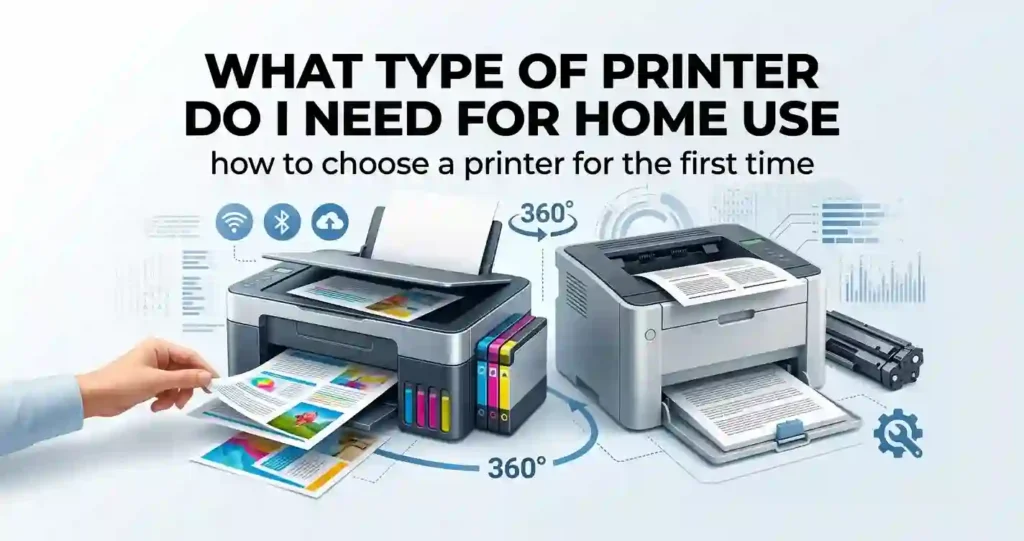
When evaluating long-term printing expenses, home printers generally fall into three distinct categories: refillable ink tank printers, traditional cartridge-based inkjets, and monochrome laser printers. Each technology manages consumable costs differently.
Ink Tank Printers
Refillable ink tank printers (such as Epson EcoTank, Canon MegaTank, and HP Smart Tank) swap small, expensive plastic cartridges for large, built-in reservoirs.
- Refillable Reservoirs: You pour liquid ink directly into clear tanks on the printer.
- Bottled Ink: Replacement ink comes in high-capacity bottles that cost significantly less per fluid ounce than traditional cartridges.
- High Page Yields: A single set of ink bottles can print between 4,000 and 7,500 pages.
- Ultra-Low Cost Per Page: Color printing costs routinely drop below 1 cent per page.
These printers are exceptionally economical for families, students, and home offices that print frequently.
Cartridge-Based Inkjet Printers
Traditional inkjet printers rely on small plastic cartridges containing fixed amounts of ink.
- Standard vs. High-Yield: Standard cartridges yield around 150 to 200 pages, while high-yield (XL or XXL) variants offer 300 to 500 pages.
- Frequent Replacements: Low page capacities require frequent cartridge swaps, driving black-and-white printing costs to 5–10 cents per page and color printing to 15–25 cents per page.
- Elevated Long-Term Expenses: High ongoing cartridge costs often eclipse the initial cost of the printer within six to twelve months.
Monochrome Laser Printers
Monochrome laser printers use heat to fuse dry toner powder onto paper rather than spraying liquid ink.
- Toner-Based Efficiency: Toner cartridges rarely dry out, making them highly reliable for text documents.
- High Yield & Speed: A single toner cartridge typically prints between 1,200 and 3,000 pages at fast print speeds.
- Low Maintenance: Laser printers eliminate printhead clogging issues common in seldom-used inkjet devices.
For households that only print text documents, black-and-white forms, and shipping labels, a monochrome laser printer offers exceptionally low operating costs.
What Makes a Printer Cheap to Run?
A printer’s affordability depends on its overall running efficiency rather than its retail price tag.
Ink Cost Per Page
Cost per page (CPP) is the single most accurate metric for measuring ongoing expenses. Calculate CPP using this formula:
$$\text{Ink Cost Per Page} = \frac{\text{Price of Ink Bottle or Cartridge}}{\text{Estimated Page Yield}}$$
Always calculate black-and-white and color printing costs separately. Black text documents require only one black cartridge, whereas color pages consume multiple color channels simultaneously. Keep in mind that real-world costs vary based on page coverage—a dense photo uses far more ink than a double-spaced essay.
Page Yield
Manufacturer-rated page yields follow standard ISO/IEC testing standards, which assume roughly 5% ink coverage per page (similar to a standard business letter).
- Standard vs. High-Yield Cartridges: XL and XXL cartridges cost slightly more upfront but drastically lower the CPP.
- Advertised vs. Real-World Yield: Full-page photos, heavy graphic designs, or high-density text consume ink faster than ISO testing benchmarks.
Total Cost of Ownership
To calculate the true cost of a printer, compute its Total Cost of Ownership (TCO) over its lifespan:
$$\text{TCO} = \text{Initial Printer Price} + \text{Lifetime Ink/Toner Costs} + \text{Paper} + \text{Maintenance}$$
A $250 ink tank printer with 1-cent pages is far cheaper over three years than a $50 cartridge printer with 10-cent pages.
Ink Tank vs. Cartridge Printer: Which Saves More Money?
Choosing between an ink tank and a cartridge printer depends primarily on how much you print each month.
| Factor | Ink Tank Printer | Cartridge Printer |
| Upfront Cost | Often higher ($200 – $450) | Often lower ($50 – $120) |
| Ink Cost | Usually lower per page ($0.003 – $0.01) | Often higher per page ($0.05 – $0.20) |
| Page Yield | High (4,000 – 7,500 pages per set) | Low to moderate (150 – 500 pages) |
| Refill Method | Bottled ink poured into tanks | Snap-in plastic cartridges |
| Best For | Frequent, high-volume home printing | Occasional, light printing |
- Low-Volume Printing (Under 20 pages/month): A low-cost cartridge printer or monochrome laser printer limits upfront investment.
- Moderate to High-Volume Printing (50+ pages/month): An ink tank system pays for itself quickly through massive per-page ink savings.
How Much Can You Save With a Low-Ink-Cost Printer?
Your monthly print volume determines whether an expensive printer with low ink costs will save you money.
       ESTIMATED 3-YEAR TOTAL PRINTING COSTS
  (Initial Printer Purchase Price + 3 Years of Ink)

$800 |-------------------------------------------------
     |                                      [ $740 ]
$600 |                                 :'''''''''
     |                            :''''
$400 |                       :''''          [ $310 ]
     |                  :''''          ......''''
$200 |    [ $110 ] :''''         ......''
     |      ...'''.........'''''
  $0 +-------------------------------------------------
         Occasional              Moderate           High-Volume
        (15 pgs/mo)            (100 pgs/mo)         (300 pgs/mo)

         ...... Ink Tank Printer ($200 Base + $0.01/pg)
         :'''''' Cartridge Printer ($50 Base + $0.15/pg)
Occasional Home Printing (15 Pages/Month)
- Cartridge Printer (CPP: $0.15): $50 printer + $81 ink over 3 years = $131 total
- Ink Tank Printer (CPP: $0.01): $200 printer + $5.40 ink over 3 years = $205.40 total
Verdict: For ultra-light printing, a low upfront printer cost can outweigh page-yield advantages.
Moderate Family Printing (100 Pages/Month)
- Cartridge Printer (CPP: $0.15): $50 printer + $540 ink over 3 years = $590 total
- Ink Tank Printer (CPP: $0.01): $200 printer + $36 ink over 3 years = $236 total
Verdict: An ink tank printer saves roughly $354 over three years for typical family use.
High-Volume Home Printing (300 Pages/Month)
- Cartridge Printer (CPP: $0.15): $50 printer + $1,620 ink over 3 years = $1,670 total
- Ink Tank Printer (CPP: $0.01): $200 printer + $108 ink over 3 years = $308 total
Verdict: High-volume users save upwards of $1,362 over three years by switching to continuous ink tank systems.
Printer Features That Help Reduce Ink Costs
Hardware and software features built into modern printers can help reduce your overall operating expenses.
Automatic Duplex Printing
Automatic duplexing prints on both sides of a page without manual intervention. Printing two-sided documents immediately cuts paper consumption by up to 50%, saving money on paper reams over time.
Draft and Economy Print Modes
Draft or economy modes reduce saturation levels to save ink when printing casual reference documents, recipes, or internal notes. Save high-resolution settings for final reports or photo printing.
Separate Color Ink Cartridges
Printers with individual color channels (Cyan, Magenta, Yellow, Black) allow you to replace only the color that has run out. Combined “tri-color” cartridges force you to discard remaining ink if a single color depletes prematurely.
Wi-Fi and Mobile Printing
Modern connectivity features like Wi-Fi, Apple AirPrint, and Mopria allow direct printing from smartphones and tablets. While mobile connectivity does not lower ink costs directly, mobile apps often include preview features that prevent accidental re-prints.
Does Print Quality Affect Ink Usage?
Higher DPI (dots per inch) settings and print quality choices directly influence ink consumption.
Text Documents
Standard black text uses minimal ink. Printing text in Draft Mode reduces ink consumption while keeping letters sharp and legible. For text-heavy workflows, monochrome laser printers remain the gold standard for efficiency.
Color Documents
Graphics, charts, and colored presentation slides consume considerably more ink than plain text. To minimize supply usage, print draft copies of color documents in grayscale.
Photo Printing
Printing edge-to-edge photos at full DPI resolution uses substantial liquid ink.
  TYPICAL INK CONSUMPTION BY DOCUMENT TYPE

  Plain Text (5% Coverage)   [██] (Minimal)
  Color Chart (15% Coverage) [██████] (Moderate)
  Full Photo (100% Coverage) [████████████████████] (Heavy)
Because photo printing demands maximum coverage, prioritizing ultra-low cost-per-page ink tanks is essential if you regularly print glossy prints at home.
How to Calculate the Cheapest Printer to Run
Follow this simple method to estimate total printing costs before purchasing a home printer:
- Calculate Black & Color Cost Per Page:$$\text{Black CPP} = \frac{\text{Black Cartridge Price}}{\text{Black Page Yield}}$$$$\text{Color CPP} = \frac{\text{Color Cartridge Set Price}}{\text{Color Page Yield}}$$
- Estimate Annual Ink Expenses:$$\text{Annual Ink Cost} = (\text{Monthly Pages} \times 12) \times \text{Average Cost Per Page}$$
- Calculate Total Operating Expense over 3 Years:$$\text{3-Year Cost} = \text{Printer Purchase Price} + (\text{Annual Ink Cost} \times 3)$$
Common Mistakes That Make Home Printing More Expensive
- Buying Based Only on Printer Price: Purchasing an inexpensive printer without checking cartridge prices leads to high operating expenses down the road.
- Ignoring Ink Availability: Choose printers with readily available ink bottles or cartridges from standard US retailers like Amazon, Best Buy, and Staples.
- Overlooking Monthly Print Volume: Buying an industrial ink tank printer for 5 pages a month wastes money upfront, while buying a $40 cartridge printer for 300 pages a month causes long-term overspending on consumables.
Which Home Printer Is Best for Different Printing Needs?
Matching printer technology to household habits ensures optimal value.
Best Type for Occasional Printing
If you print fewer than 15 pages a month, purchase a compact monochrome laser printer or an entry-level cartridge printer. Toner powder in laser printers never dries out or clogs printheads during long periods of inactivity.
Best Type for Families
Families managing homework, permission slips, recipes, and craft projects benefit most from a refillable ink tank printer. High yields absorb unpredictable printing spikes without constant trips to the store for ink.
Best Type for Home Offices
Home offices requiring fast document turnaround need a monochrome laser printer or a high-speed business ink tank. Look for automatic duplexing, high-capacity paper trays, and low cost-per-page operation.
Best Type for Photo Printing
Dedicated photo enthusiasts should choose photographic ink tank printers using 5 to 6 specialized dye-based inks. They balance color accuracy with manageable per-print costs.
How to Choose a Home Printer That Saves Money on Ink
To select the right model, evaluate your usage before shopping:
- Establish your average monthly print volume and color-to-black-and-white ratio.
- Multiply expected annual pages by manufacturer-rated CPP estimates.
- Select a printer that yields the lowest Total Cost of Ownership over 3 to 5 years.
Quick Printer Buying Checklist
- [ ] Rated black page yield and replacement cost verified
- [ ] Rated color page yield and replacement cost verified
- [ ] Automatic duplexing supported
- [ ] Wireless/mobile printing supported
- [ ] Replacement supplies easily sourced at US retailers
Frequently Asked Questions About Saving Money on Printer Ink
Which type of home printer has the cheapest ink?
Refillable ink tank printers offer the lowest ongoing ink costs. Replacement ink bottles cost significantly less than traditional plastic cartridges while delivering thousands of printed pages per bottle.
Are ink tank printers cheaper than cartridge printers?
Ink tank printers cost more upfront, but they are significantly cheaper over time for anyone printing more than 30 to 50 pages per month due to their ultra-low cost per page.
What printer has the lowest cost per page?
Refillable ink tank printers and high-yield monochrome laser printers offer the lowest cost per page, often reaching below 1 cent per page for black text.
Is it cheaper to use an inkjet or laser printer at home?
For text-only printing, monochrome laser printers are often cheaper and more reliable. For high-volume color documents, refillable ink tank inkjets provide the best value.
How long does printer ink last?
Unopened printer ink cartridges and bottles typically last up to 2 years. Once installed in an active printer, bottled ink in tank printers can last over a year without drying out.
Do refillable ink printers really save money?
Yes. High page yields paired with inexpensive bottled ink can reduce home printing costs by 80% to 90% compared to traditional cartridge-based devices.
Is it cheaper to buy an expensive printer with cheap ink?
For moderate to heavy users, buying a higher-priced printer with low ink costs saves substantial money over the lifespan of the machine.
Does printing in draft mode save ink?
Yes. Draft or economy modes apply less liquid ink or toner to the page, extending supply life for informal document printing.
How can I reduce my printer ink costs?
Use automatic duplexing, print draft copies for everyday documents, select grayscale mode for text files, and switch to a high-yield ink tank or laser system.
What should I calculate before buying a home printer?
Calculate average monthly page count, estimated cost per page, total 3-year running expenses, and upfront hardware costs to determine the true overall cost.
Conclusion: Find the Home Printer With the Lowest Long-Term Ink Cost
Choosing a home printer that saves money on ink requires looking beyond the initial retail sticker price. High-capacity ink tank printers and efficient laser printers cost more upfront, but their ultra-low cost per page delivers substantial savings over time for active households.
By matching print technology to your family’s actual volume, checking cartridge yields, and calculating total operating expenses, you can select a reliable home printer that keeps long-term costs as low as possible.