Choosing between buying and leasing a printer is one of those decisions that feels small until the invoices start arriving. The right choice depends on your print volume, your upfront budget, your cash flow, your maintenance tolerance, and how fast your business is growing.
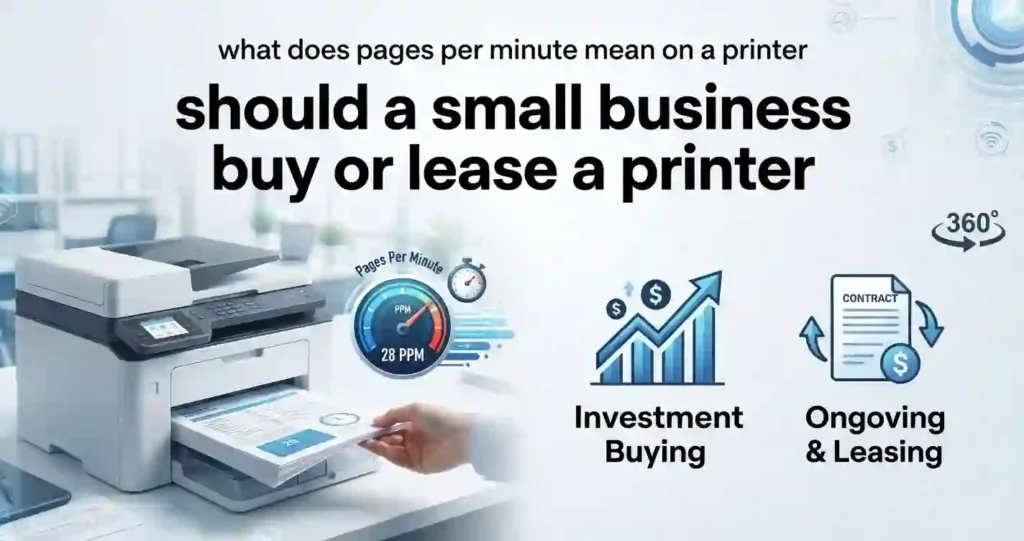
Buying means paying once and owning the hardware outright. Leasing means making recurring payments for the right to use equipment, often bundled with maintenance or service. Neither path is universally correct for every small business, and the office that gets this decision right usually looked past the sticker price first.
This guide walks through the cost, hardware, maintenance, connectivity, and long-term factors you should weigh before signing anything. If you are still building the basics of printer knowledge, our guide on choosing a printer for the first time is a useful companion piece.
Printer Buying vs. Leasing: What’s the Difference?
Buying a printer means paying the full price upfront and owning the printer and any related hardware from day one. You are responsible for supplies, repairs, and eventual replacement, but you owe nothing after the purchase clears.
Leasing a printer means making recurring payments, usually monthly, for the use of equipment that a leasing company still owns. Many leases bundle in maintenance or service options, which can simplify budgeting even if it raises the long-term price.
A few related terms come up constantly in this conversation. An equipment lease is the contract itself. Managed print services (MPS) go further, monitoring usage and automatically replenishing supplies. A copier lease works the same way as a printer lease but usually applies to higher-volume multifunction devices. A printer service agreement covers repairs and maintenance separately from ownership. Understanding these printer specifications and terms upfront prevents confusion later in the buying process.
What Does It Mean to Buy a Business Printer?
Buying involves an upfront purchase price, full ownership, a manufacturer warranty, and responsibility for supplies and repairs once that warranty expires. Reviewing printer warranty terms before you buy helps you know exactly when that responsibility shifts to you.
Ownership tends to make sense for businesses with predictable print requirements and enough capital to absorb the initial cost. You keep the equipment as long as you want, with no contract governing its use.
Options here include laser printers, inkjet printers, multifunction printers (MFPs), and dedicated business-class printers. Matching the hardware type to your workload matters more than the brand name on the box, so it helps to know what printer features actually matter before comparing models.
What Does It Mean to Lease a Business Printer?
Leasing spreads the cost into monthly payments, which reduces the initial cash requirement significantly compared to buying outright. This appeals to newer businesses that want capable equipment without draining working capital.
Lease terms typically include a set duration, a service contract, a maintenance agreement, and defined end-of-lease options such as buying the equipment, returning it, or upgrading to something newer. Businesses looking to keep their printer expenses predictable often favor this structure.
Review the total lease cost across the full term, not just the monthly number. A low monthly payment stretched over five years can quietly cost more than buying the same printer twice.
Should a Small Business Buy or Lease a Printer?
A small business may benefit from buying a printer when it has enough cash for the upfront investment, predictable print volume, and a preference for long-term ownership. Leasing is worth considering when preserving cash flow, securing regular service, or upgrading equipment on a schedule matters more than outright ownership.
Base the decision on budget, monthly print volume, expected equipment lifespan, maintenance needs, and growth plans. Calculating how much you should spend on a printer is a good starting point before comparing quotes.
Always calculate the total cost of ownership (TCO) before deciding either way. The cheapest monthly payment is not automatically the lowest overall cost, since fees, consumables, and service charges add up differently across each option.
When Buying a Printer May Make Sense
Businesses with low-to-moderate and predictable monthly page volume typically do well with ownership. So do businesses that expect to keep the same printer for several years without needing an upgrade.
Owners who simply want to avoid ongoing payment obligations often lean toward buying, even if it means a larger check today. Understanding why cheap printers can cost more over time helps you avoid buying the wrong hardware just to save money upfront.
When Leasing a Printer May Make Sense
Companies that need higher-end multifunction equipment without a large upfront payment often turn to leasing instead. Offices that value predictable service and maintenance costs also benefit, since many leases fold repairs into the monthly fee.
Growing businesses expecting changing print volumes or equipment requirements gain flexibility from leasing that ownership does not offer. Recurring printer downtime problems are also easier to manage when a service contract guarantees a repair response window.
Printer Buying vs. Leasing Cost Comparison
The sticker price is only one part of the equation. As a printing-technology specialist, I recommend comparing upfront costs, monthly payments, consumables, maintenance, downtime, and end-of-term costs to determine the real cost of each option.
| Cost Factor | Buying | Leasing |
|---|---|---|
| Upfront cost | Higher | Usually lower |
| Monthly payment | None after purchase | Recurring |
| Ownership | Business owns printer | Depends on lease terms |
| Maintenance | Owner’s responsibility after warranty | May be included or separate |
| Toner/ink | Usually separate | Usually separate or bundled |
| Upgrades | Owner purchases new equipment | May be easier at lease renewal |
| Long-term cost | Can be lower after payoff | Can increase over multiple terms |
| Cash flow | Larger initial expense | More predictable monthly expense |
Calculate 3-year and 5-year ownership costs for both scenarios before committing to either one. Include the purchase price, financing interest, lease fees, service contracts, toner or ink, paper, repairs, and disposal costs.
Read every lease agreement carefully for hidden fees, page allowances, excess-page charges, and buyout provisions. Learning about true cost of ownership before signing anything protects you from surprises at renewal time.
Calculate the Total Cost of Ownership Before You Decide
The total cost of a business printer includes more than its purchase or lease payment. Calculate the following before making a final decision:
- Printer or lease payments
- Ink or toner costs
- Paper costs
- Maintenance and repairs
- Service contracts
- Electricity
- Replacement parts
- Financing or lease fees
Working through this list gives you a realistic picture that a sales quote rarely shows on its own. Our breakdown of how to calculate office printing costs walks through each line item in more depth.
Calculate Cost Per Page
Cost per page (CPP) measures how much each printed page actually costs once you factor in ink or toner, and it matters far more than the sticker price of a single cartridge. Two printers with identical purchase prices can have wildly different running costs once CPP is factored in.
Compare cartridge yield against your expected monthly page volume rather than comparing cartridge prices in isolation. Look closely at ISO page yield, high-yield cartridge options, standard toner yield, and the price gap between color and black-and-white printing, since color pages typically cost several times more per page. Reviewing inkjet running costs alongside laser CPP figures makes the comparison much clearer, and checking how long toner typically lasts helps you forecast supply purchases accurately.
Estimate Your Monthly Print Volume
Review historical invoices, existing print logs, or printer usage reports wherever they are available to you. Guessing at volume is one of the most common ways small businesses overpay for either option.
Separate black-and-white pages from color pages, since the cost difference between them is significant. Account for seasonal spikes tied to marketing campaigns, invoicing cycles, reports, and customer documents. Tools that help you monitor office printer usage make this estimate far more reliable than a rough guess, and knowing how many pages an office printer can realistically handle monthly keeps expectations grounded.
How Much Does a Small Business Printer Cost?
Entry-level business printers, midrange laser printers, and multifunction devices span a wide price range depending on capability. Printer price varies based on print speed, duty cycle, paper capacity, duplex printing, connectivity, and finishing features.
Factor in the ongoing cost of toner, ink, drums, maintenance kits, and replacement parts alongside the sticker price. Avoiding common printer buying mistakes at this stage saves real money over the life of the machine.
Upfront Printer Costs
The purchase price often comes with optional accessories such as additional paper trays that add to the total. Wireless and networking features, along with an automatic document feeder (ADF), also influence price.
Consider whether a single multifunction printer can replace separate scanning, copying, and fax equipment in your office. Comparing which printer features are worth paying extra for can prevent you from overspending on capabilities you will rarely use.
Recurring Printing Costs
Ink or toner represents the largest ongoing expense for most small businesses, followed by replacement drums, fusers, maintenance kits, and printheads where applicable. Understanding the drum vs. toner cartridge distinction helps you budget for laser printer upkeep accurately.
Paper, electricity, repairs, and service agreements round out the recurring cost picture. None of these show up on the original price tag, which is exactly why they get overlooked.
Buy vs. Lease Based on Business Size and Print Volume
| Business Situation | Typical Consideration | Key Printer Needs |
|---|---|---|
| Home-based business | Buying may be practical | Compact, wireless, affordable |
| Small office | Compare both options | Reliable network printing |
| Growing office | Evaluate leasing and buying | Scalability, higher duty cycle |
| High-volume office | Consider service-inclusive options | Fast printing, high paper capacity |
| Customer-facing business | Focus on reliability | Color quality and low downtime |
Employee count alone does not determine printer requirements, no matter how tempting that shortcut feels. Focus on monthly page volume and peak workloads instead, since those numbers reveal the actual demand on the equipment.
Duty cycle and recommended monthly volume are two different specifications that often get confused. A printer’s recommended monthly volume reflects sustainable everyday use, while duty cycle represents an occasional maximum ceiling. Our guide on choosing a printer for a small office explains this distinction with concrete examples, and matching a printer to your monthly print volume walks through the math step by step.
Laser vs. Inkjet: Which Printer Type Should a Small Business Choose?
The laser versus inkjet debate shapes every buy-or-lease decision, since the technology you choose determines your running costs for years. Our full laser vs. inkjet comparison for everyday documents covers the fundamentals if you need a refresher.
Business Laser Printers
Laser printers offer fast print speeds, efficient handling of high-volume documents, and consistently sharp text quality. Understanding how laser printer technology works explains why they hold up so well under heavy daily use.
Monochrome laser printers suit text-heavy offices, while color laser models add versatility for marketing materials and client-facing documents. Comparing monochrome vs. color laser printers side by side clarifies which fits your workload.
Automatic duplex printing, high-yield toner, duty cycle, and paper capacity all deserve attention when comparing models. Weighing the advantages and disadvantages of laser printers against your specific needs prevents buyer’s remorse.
Business Inkjet Printers
Inkjet printers deliver strong color output and can suit graphics-heavy documents better than most laser models. Reviewing the advantages and disadvantages of inkjet printers helps set realistic expectations for a business setting.
Cartridge-based systems differ significantly from ink tank or supertank systems in both upfront price and long-term running cost. Comparing cartridge printers against refillable tank systems reveals which one actually saves money at your print volume.
Multifunction Printers
Multifunction printers combine printing, scanning, copying, and optional fax capability into a single device. An automatic document feeder, duplex scanning, network scanning, and touchscreen controls all add convenience for a busy office.
Consolidating multiple office devices into one multifunction printer can meaningfully reduce equipment costs. Weighing all-in-one printers against single-function printers helps determine whether consolidation makes sense for your space.
Printer Features Small Businesses Should Evaluate
Print Speed and Duty Cycle
Pages per minute (PPM) describes how fast a printer produces output, but advertised maximum speeds often differ from real-world performance. Reviewing what pages per minute actually means clears up a spec that gets misunderstood constantly.
Match duty cycle and recommended monthly volume to your expected workload rather than the largest number on the spec sheet. Checking how many pages a laser printer can realistically print over its lifespan gives useful context for this comparison.
Print Quality and Resolution
DPI, or dots per inch, measures resolution and affects text sharpness, graphics clarity, and photo quality. A higher DPI number is not the only measure of print quality worth considering, since engine design and toner formulation matter too. Our explainer on printer resolution breaks this concept down in plain language.
Color accuracy, grayscale quality, and consistency across a print run also deserve attention, especially for customer-facing documents.
Connectivity and Networking
Wi-Fi, Ethernet, USB, Wi-Fi Direct, AirPrint, and Mopria all represent different ways to connect a printer to your office devices. Network compatibility matters more in a small-office environment than most buyers expect, especially once several employees need shared access.
Security considerations for network-connected printers are easy to overlook but genuinely important. Learning how to share a printer across an office network properly, along with the fundamentals of office printer security, protects sensitive business documents from unauthorized access.
Paper Handling
Paper capacity, multipurpose trays, envelope printing, and supported media sizes vary widely between models. Automatic duplex printing can meaningfully reduce paper consumption across a busy office.
Additional paper trays may be worth the added cost for offices with higher workloads. Reviewing our guide to choosing paper for office documents ensures compatibility issues never slow down your printing.
What to Look for in a Small Business Printer Lease
Check the lease length, monthly payment, interest or finance charges, service coverage, and end-of-term conditions before signing anything. Determine whether toner, maintenance, repairs, and replacement parts are included in the quoted price.
Review page allowances closely alongside potential overage charges, since these fees can quietly inflate a lease that looked affordable at first glance. Comparing a cheap printer against genuinely low-cost printing applies just as much to lease terms as it does to purchase price.
Questions to Ask a Printer Leasing Company
Ask what the total amount paid over the full lease term will be, not just the advertised monthly figure. Find out exactly what happens when the lease ends, including return conditions and buyout pricing.
Confirm whether repairs, labor, toner, and replacement parts are included in the service agreement. Ask whether minimum monthly page requirements or excess-page fees apply, since these details rarely appear in marketing materials.
Printer Maintenance: Buying vs. Leasing
Ownership makes the business responsible for routine maintenance and repairs once the manufacturer warranty expires. Leasing typically shifts at least some of that responsibility to the leasing company, depending on the specific contract terms.
Toner or ink replacement, cleaning, firmware updates, rollers, drums, fusers, and printheads all require attention over a printer’s lifespan. Understanding laser printer maintenance requirements helps you budget time and money accordingly, whether you own or lease.
Service response times can significantly affect employee productivity when a printer goes down mid-project. Knowing how often an office printer should be maintained helps you catch problems before they cause downtime, and understanding why office printers stop working frequently helps you diagnose recurring issues faster.
Managed Print Services for Small Businesses
Managed print services (MPS) go beyond a basic printer lease by adding monitoring, automated supply replenishment, device management, and dedicated service support. This model works well for offices juggling multiple devices across several employees.
MPS may be excessive for a very small office with a single printer and light workload. Reviewing common office printing mistakes can help you decide whether the added structure of MPS solves a real problem or adds unnecessary cost.
Common Printer Leasing Mistakes to Avoid
Choosing a lease based solely on the monthly payment is the single most common mistake small businesses make. Signing a long contract without calculating total costs across the full term compounds that mistake further.
Ignoring page limits, overage fees, automatic renewals, or buyout terms can turn an affordable-looking lease into an expensive one. Failing to verify what the service agreement actually covers leaves businesses exposed when equipment breaks down. Reviewing common laser printer problems in advance helps you ask sharper questions about what a service contract will and will not fix.
Don’t Ignore Consumable Costs
Compare toner cartridge yield, ink cartridge yield, cost per page, and high-yield cartridge options before finalizing any decision. These numbers matter far more over a three-year period than the initial purchase price.
Color printing can significantly increase consumable costs compared to black-and-white output alone. Third-party supplies sometimes undercut OEM pricing, but weigh that savings against warranty and reliability considerations, and consider browsing affordable laser printers with low toner costs if consumables are your biggest concern.
How to Decide Whether to Buy or Lease a Printer
Follow this step-by-step process to reach a confident decision:
- Calculate your average monthly page volume.
- Determine your available upfront budget.
- Estimate ink or toner cost per page.
- Compare purchase and lease total costs.
- Evaluate maintenance and service requirements.
- Check connectivity, speed, paper handling, and print quality.
- Review the lease contract or printer warranty.
- Choose the option that fits your projected business needs.
Printer Buying Checklist
- Purchase price and financing terms
- Page yield and cost per page
- Print speed and duty cycle
- Warranty and support
- Connectivity and security
Printer Leasing Checklist
- Monthly payment and total contract cost
- Lease duration and renewal terms
- Service and maintenance coverage
- Page allowance and overage fees
- End-of-lease purchase, return, or upgrade options
Buy or Lease a Printer? A Practical Decision Framework
| Factor | Questions to Ask | Why It Matters |
|---|---|---|
| Budget | Can you comfortably pay upfront? | Determines cash-flow impact |
| Print volume | How many pages do you print monthly? | Influences hardware and consumable costs |
| Growth | Will volume increase? | Helps determine scalability |
| Maintenance | Who handles repairs? | Affects downtime and labor |
| Technology | Do you need current features? | Impacts upgrade flexibility |
| Ownership | Do you want to own the equipment? | Affects long-term costs |
| Contract | Are there fees or usage limits? | Prevents unexpected costs |
Use your actual printing data instead of relying on generic averages when running these numbers. A 3-year total-cost comparison can reveal differences that monthly payments alone tend to hide.
Compare at least two purchase options and two lease or service proposals whenever possible. If your volume runs high, browsing laser printers built for high-volume printing or a color laser printer designed for small business use can narrow your search considerably.
Frequently Asked Questions About Buying or Leasing a Printer
Is it cheaper to buy or lease a printer for a small business?
The answer depends on the purchase price, lease financing, service costs, consumables, and how long the business keeps the printer. A total-cost comparison across three to five years gives a far more accurate answer than comparing monthly payments alone.
What are the disadvantages of leasing a printer?
Leasing involves long-term contractual obligations, recurring payments, possible hidden fees, and specific conditions at the end of the term. Page allowances and service-contract limitations can also restrict how the equipment gets used day to day.
What are the advantages of buying a business printer?
Buying gives you full ownership, eliminates ongoing lease payments after the purchase is paid off, and gives you greater control over when to replace the equipment. In exchange, the business assumes maintenance and eventual replacement responsibility.
How long should a small business keep a printer?
Expected lifespan depends on workload, reliability, repair costs, and how quickly the technology around it changes. Repeated repairs eventually make replacement more practical than continued patching, and our laser printer lifespan guide offers useful benchmarks for that decision.
Is a printer lease tax deductible for a small business?
Tax treatment can depend on the specific lease structure and your business’s individual circumstances. Consult a qualified tax professional for current US tax guidance before assuming any deduction applies.
Does leasing a printer include toner?
Toner may or may not be included, depending entirely on the specific service agreement you sign. Always verify consumables, page allowances, and overage charges before treating a lease quote as final.
What is a good cost per page for a business printer?
Acceptable cost per page varies by printer type, whether output is black-and-white or color, and overall print volume. Comparing ink or toner yield alongside total consumable cost, rather than cartridge prices alone, gives a clearer picture, and a laser printer chosen specifically for low running costs can meaningfully lower this number.
Is a laser printer better for a small business?
Laser printing tends to work best for high-volume text documents that need consistent, fast output. Inkjet and ink-tank printers can be a better fit for color-heavy or lower-volume workloads instead.
Can a small business lease a multifunction printer?
Multifunction printers are commonly available through equipment leasing and managed print arrangements. Printing, scanning, copying, faxing, an ADF, duplexing, and network features are all standard on leased MFP models.
What should I check before signing a printer lease?
Review the total contract cost, term length, service coverage, page allowances, overage charges, and end-of-term options carefully. Confirm exactly which supplies and repairs are included before you sign anything.
Final Verdict: Buy or Lease a Printer for Your Small Business?
The decision ultimately comes down to cash flow, print volume, ownership preference, maintenance tolerance, scalability, and total cost of ownership rather than simply the monthly price. Businesses that calculate their expected cost per page and 3-year total printing cost before committing tend to make far fewer expensive mistakes.
Take time to review printer specifications, warranty terms, service agreements, and lease conditions carefully before signing anything. Neither option is inherently superior, but one will genuinely fit your business better once the numbers are laid out honestly.
Compare Your Printer Options Before You Commit
Calculate your monthly page volume and cost per page before requesting any quotes. Compare suitable business laser printers, inkjet or ink-tank printers, and multifunction printers against your actual workload rather than a generic recommendation.
For further reading, explore our guides on reducing printer expenses in a small business, energy consumption for office printers, and calculating the true cost of owning a printer before you make a final call.