printer flashes a low ink warning right before a big print job. Then you see the price of a new cartridge at Staples or Best Buy. It stings.
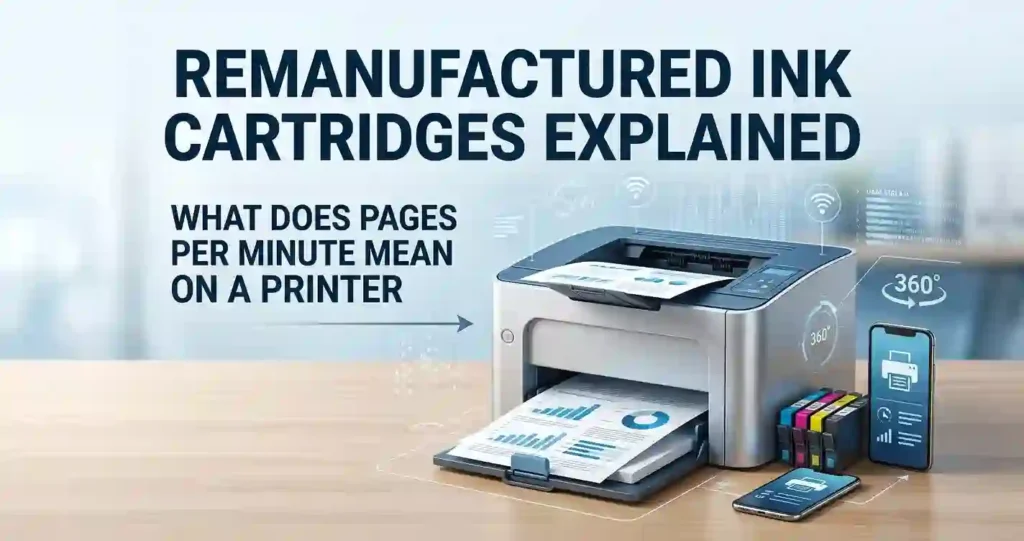
Remanufactured ink cartridges are used cartridges that a company collected, cleaned, refilled, and tested for another round of printing. They are not the same as new OEM cartridges made by your printer’s brand. The shell is reused, and quality depends on the remanufacturer.
Home users, students, and small offices often choose them for everyday document printing. The main draw is a lower price. If you already wonder why printer ink costs so much, this guide shows where remanufactured ink fits.
You will learn how these cartridges work, how they compare, what they cost per page, and how to fix common problems. You will also get a simple buying checklist.
What Are Remanufactured Ink Cartridges?
Remanufactured ink cartridges are previously used cartridges that have been collected, inspected, cleaned, refilled, and tested for reuse. Think of them as a recycled shell with a fresh load of ink.
Three terms confuse many shoppers:
- Remanufactured: an original cartridge, restored and reused.
- Compatible: a new cartridge built by a third party.
- OEM: a new cartridge built by the printer maker, such as HP, Canon, Epson, or Brother.
Every cartridge has the same core parts. The ink reservoir holds the liquid. The cartridge housing protects it. Electrical contacts talk to the printer. Some designs also include a printhead, the part that sprays ink onto paper. Our guide on how inkjet printers work shows how these parts fit together.
How Are Ink Cartridges Remanufactured?
The typical process has six steps:
- Collection: used OEM cartridges arrive through recycling programs.
- Inspection: workers remove cracked or worn shells.
- Cleaning: old ink and dust come off.
- Refilling: fresh ink goes in.
- Component replacement: worn chips, seals, or parts are swapped.
- Quality testing: the cartridge is checked for leaks, flow, and print output.
Some cartridges get new seals or parts because rubber and plastic wear out. Standards vary between remanufacturers, so the seller matters a lot.
Integrated Printhead Cartridges
Some cartridges, common in HP and Canon models, include the printhead. The remanufacturer must clean or replace it. A worn printhead can cause streaks, so this step is vital. Our page on the inkjet printhead for beginners explains why.
Cartridges Without a Printhead
Other printers keep the printhead inside the machine. Many Epson models work this way. The cartridge mostly holds ink, so the job is simpler. Poor ink can still clog the printer’s own printhead, though.
Are Remanufactured Cartridges the Same as Used Cartridges?
No. A used cartridge that someone simply refilled with a syringe is not the same as a professionally remanufactured one.
Professional work includes cleaning, inspection, testing, and component replacement. Those steps catch cracks, worn seals, and weak chips.
Cartridge condition affects print quality and reliability. A dirty or worn cartridge can leak, clog, or print faded pages. Choose sellers who describe their process clearly.
How Do Remanufactured Ink Cartridges Work?
The cartridge supplies liquid ink to the printer’s printhead. Tiny nozzles spray droplets onto paper to form text and images.
Ink must flow steadily from the reservoir to those nozzles. The electrical contacts link the cartridge to the printer. The printer reads a chip to recognize the cartridge, track ink level, and confirm the model.
Printer firmware can affect compatibility. A firmware update may change how the printer treats chips from non-OEM cartridges. That is one reason a cartridge can work for months and then trigger an error.
Do Remanufactured Cartridges Work in Any Printer?
No. Cartridges are model-specific. They must match your printer’s cartridge number, such as HP 67 or Brother LC401.
Chip recognition and firmware also matter. Wi-Fi or USB connectivity does not change which cartridge fits.
Check the exact printer model before you buy. You can usually find it on the front or back of the machine. Our printer specifications guide for beginners helps you read those labels.
What Happens When a Printer Does Not Recognize One?
You may see “cartridge not recognized,” “low ink,” or “cartridge problem.” These messages sound scary, but many have simple fixes.
Check these first:
- The cartridge is fully seated.
- The protective tape is removed.
- The electrical contacts are clean and dry.
- The cartridge number matches your printer.
If the error stays, replace the cartridge or contact the seller. See common inkjet printer problems and their causes for other error types.
Remanufactured vs. OEM vs. Compatible Ink Cartridges
Here are the three categories in plain terms:
- Remanufactured: a reused original cartridge, cleaned, refilled, and tested.
- OEM: a new cartridge from the printer manufacturer.
- Compatible: a new cartridge made by another company to fit your printer.
Compare purchase price, expected page yield, print quality, compatibility, and warranty. Do not treat the words “compatible” and “remanufactured” as the same thing. One is new, and the other is reused.
If you want to skip cartridges altogether, read ink cartridge printer vs refillable tank.
Quick Comparison of Ink Cartridge Types
For readers comparing cartridge options, the key differences are usually price, manufacturing process, compatibility, and expected performance. Use the table below as a quick side-by-side reference.
| Feature | Remanufactured | OEM | Compatible |
|---|---|---|---|
| Original manufacturer | Reused/refurbished cartridge | Printer manufacturer | Third-party manufacturer |
| Typical price | Often lower | Usually higher | Often lower |
| Cartridge construction | Reused cartridge shell/components | New | New |
| Cleaning/testing | Varies by supplier | Manufacturer-controlled | Varies by supplier |
| Page yield | Depends on product | Manufacturer-rated | Depends on product |
| Print quality | Can vary by brand | Generally consistent | Can vary |
| Warranty | Seller/manufacturer dependent | Manufacturer dependent | Seller/manufacturer dependent |
| Printer compatibility | Model-specific | Model-specific | Model-specific |
Prices only tell part of the story. Our breakdown of inkjet printer running costs shows what else adds up.
Are Remanufactured Ink Cartridges Good?
They can be. Performance depends heavily on the remanufacturer, cartridge condition, ink formulation, and testing process.
Watch these quality factors: color accuracy, sharpness, streaking, smudging, and nozzle performance.
User reviews and a clear product warranty help you compare suppliers. If terms confuse you, read printer warranty terms explained first.
Print Quality and Color Accuracy
For black text, many remanufactured cartridges do well. Check color saturation, gradients, and photo output when color matters.
Results can differ between brands and even between batches. DPI means dots per inch. More dots can mean finer detail, but ink quality still shapes the result. See printer resolution in simple terms.
Photo printing needs more attention to ink formulation and color consistency. Our guide to colour calibration for printers can help you fine-tune results.
Reliability and Printer Performance
Watch for clogged nozzles, uneven ink flow, leaks, and recognition errors. Most trace back to cartridge quality, storage, or installation.
Store spare cartridges well and install them carefully. Dried ink is a common culprit, so learn why an inkjet printer dries out.
A reputable seller should offer troubleshooting help or a replacement. If they do not, think twice.
How Much Do Remanufactured Ink Cartridges Cost?
Sellers market remanufactured cartridges as a lower-cost alternative to OEM supplies. Savings are real in many cases, but not guaranteed.
Compare cost per page, not just the sticker price. Add shipping, cartridge capacity, page yield, and how often you will replace the cartridge.
For the full picture, read how to calculate the true cost of owning a printer. Also see ways to reduce home printing costs.
How to Calculate Cost Per Page
Use this formula: Cartridge price ÷ estimated page yield = cost per page.
Actual yield varies with document coverage, font size, graphics, and printing frequency. Compare high-yield and standard-capacity cartridges where both exist.
Office users can follow how to compare office printer running costs for a deeper method.
Worked Example in USD
These numbers are examples, not quotes. A new OEM black cartridge costs $32 and prints 300 pages. That is about 10.7 cents per page.
A remanufactured version costs $22 and prints 250 pages. That is about 8.8 cents per page. Add $5 shipping, and it becomes $27 for 250 pages, or about 10.8 cents.
Shipping can erase savings on a single cartridge. Buy in bundles or look for free shipping.
What Is the Page Yield of a Remanufactured Ink Cartridge?
Page yield is the estimated number of pages a cartridge prints before it runs out. It lets you compare cartridges fairly.
You will see standard-yield and high-yield options. High-yield cartridges hold more ink and often cost less per page.
Advertised yields are estimates from standardized tests, which usually assume light coverage on US letter pages. Real-world use can differ. Match yield to your habits with this guide to choosing a printer for your monthly print volume.
What Affects Ink Cartridge Page Yield?
Several things change how far a cartridge goes:
- Document coverage: more ink per page means fewer pages.
- Color, images, and photos: these use far more ink than plain text.
- Cleaning cycles: frequent printhead cleaning uses ink.
- Print mode: draft, normal, and high-quality settings use different amounts.
If your ink seems to vanish, read why inkjet printers use so much ink.
Benefits of Remanufactured Ink Cartridges
- Lower upfront cost: you may save money compared with OEM cartridges. Our list of home printers that save the most on ink shows other ways to cut costs.
- Reuse of cartridge components: remanufacturing gives used cartridges another lifecycle instead of sending them to a landfill.
- Wide availability: options exist for many popular printer models. Amazon, Staples, and Office Depot list many of them.
Potential Drawbacks to Consider
- Print quality and reliability may vary between suppliers.
- Some cartridges may trigger compatibility or recognition messages.
- Warranty, return policies, and real page yield can differ a lot.
None of these are deal breakers. They are reasons to shop carefully. For a wider view, see the advantages and disadvantages of inkjet printers.
Are Remanufactured Ink Cartridges Safe for Your Printer?
Using one does not automatically damage your printer. Problems usually come from poor quality or the wrong model.
Buy a cartridge designed for your exact printer. Check the seller’s warranty, return policy, and compatibility list.
In the US, a printer maker generally cannot void your warranty only because you used a third-party cartridge. Still, damage from a faulty cartridge may not be covered.
Can Remanufactured Ink Damage a Printer?
Possible issues include leaking, poor ink formulation, clogged printheads, or incorrect fit. These are rare with good suppliers, but they happen.
Separate cartridge problems from ordinary maintenance. A printer that sat unused for weeks may clog with any ink. Read how long an inkjet printer can sit unused to rule that out.
Stop using a cartridge if it leaks or causes repeated problems. If the printer is old, check why a home printer may not be worth repairing.
How to Choose a Remanufactured Ink Cartridge
Start by verifying your printer brand, exact model number, and cartridge number. Then compare page yield, price per page, ink type, warranty, and return policy.
Ink type matters too. Dye ink gives vivid color. Pigment ink resists smudging and fading.
Look for suppliers that share quality testing details and answer questions fast. For more value ideas, see the best home printer with cheap running costs.
What Should You Check Before Buying?
Use this checklist:
- Cartridge compatibility and the printer model list.
- Standard or high-yield capacity.
- Customer reviews and seller reputation.
- Warranty coverage and return policy.
- Expiration or packaging date, explained in how long unopened ink cartridges last.
Should You Buy Standard-Yield or High-Yield?
High-yield cartridges often provide better value for frequent printing. They cost more upfront but usually less per page.
Compare the cartridge price against expected page yield. Then look at your real monthly print volume instead of choosing by size alone.
Not sure how much you print? Read how much printing a home printer should handle. Light users may never finish a large cartridge before the ink ages.
How to Install a Remanufactured Ink Cartridge
- Turn on the printer and open the cartridge access area according to the manufacturer’s instructions.
- Remove protective packaging or seals and install the cartridge firmly in the correct slot.
- Close the cover and wait for the printer to finish setting up.
- Run an alignment, nozzle check, or test page if the printer recommends it.
Afterward, confirm the level reading using how to check printer ink levels correctly.
What to Do If the Cartridge Is Not Recognized
Follow these steps in order:
- Remove and reinstall the cartridge. Check the electrical contacts for dirt or tape.
- Confirm that the cartridge number matches the printer model.
- Restart the printer and try again.
- Contact the seller for troubleshooting, replacement, or warranty support if the issue continues.
How to Store Remanufactured Ink Cartridges
- Keep unused cartridges sealed in their original packaging until needed.
- Store them in a cool, dry place away from direct sunlight and extreme temperatures.
- Follow any storage tips from the cartridge maker or seller.
Good storage prevents dried nozzles and weak ink flow. The same care applies to your paper, so see how to store printer paper at home.
Remanufactured Ink Cartridges for Home vs. Office Use
Needs differ between a kitchen table printer and a busy office. The right choice depends on volume, budget, and how much downtime you can accept.
For Home Printers
Remanufactured cartridges can save money on homework, forms, occasional documents, and everyday printing. Students will appreciate the lower cost. See our best inkjet printer for students and printer for school homework pages.
Think about shelf life if you print rarely. Ink can age before you use it. Regular use also helps, as shown in how often an inkjet printer should be used.
Prioritize dependable quality for mixed black and color documents.
For Small Offices
Focus on page yield, cost per page, reliability, and steady supply. Check the printer’s duty cycle, which is the most pages it should handle in a month. Our guide on how many pages an office printer can handle monthly explains it.
Consider high-yield cartridges for higher volumes. Connectivity, such as Wi-Fi or Ethernet, affects sharing and not cartridge choice. See network printer vs USB printer for an office.
Check warranty and replacement policies before switching. For more savings ideas, read how to reduce printer expenses in a small business.
Sample Office Math
Using the earlier example costs, an office printing 1,200 black pages a month pays about $128 with OEM cartridges. The remanufactured example costs about $106. That is roughly $22 saved each month.
If downtime costs more than that, reliability matters more than price. Track usage with how to monitor office printer usage.
Remanufactured Ink Cartridges and Print Quality
Four things shape output: ink formulation, cartridge condition, printhead performance, and paper type. Change one, and the result can change.
Common symptoms include faded text, missing colors, streaks, banding, and smudging. Our page on why inkjet prints have lines covers the banding and streak causes.
When quality drops, run the printer’s maintenance cycles first. Then check your paper. See what paper works best with inkjet printers.
Common Problems With Remanufactured Ink Cartridges
- Cartridge not recognized: often tied to compatibility, contacts, or cartridge chips.
- Faded or streaky printing: may involve ink flow, clogged nozzles, or printhead maintenance.
- Leaking or smudging: can point to a cartridge defect, poor installation, or handling.
If pages come out empty, read why an inkjet printer prints blank pages. For general troubleshooting, see common home printer problems.
When Should You Replace the Cartridge?
- Replace it when print quality stays poor after proper maintenance.
- Consider replacement if it leaks or repeatedly causes printer errors.
- Use ink-level warnings as a guide, but remember the displayed levels are estimates.
Frequently Asked Questions About Remanufactured Ink Cartridges
What is a remanufactured ink cartridge?
A remanufactured ink cartridge is a used OEM cartridge that has been collected, cleaned, refilled, and tested for reuse. The shell and some parts are recycled, while the ink is new.
Are remanufactured ink cartridges worth buying?
They can be, if you compare price, yield, quality, compatibility, and warranty. Not all remanufactured cartridges are equal. A cheap option with poor yield may cost more per page.
Are remanufactured ink cartridges as good as OEM?
OEM cartridges tend to be more consistent, with manufacturer-controlled testing. Good remanufactured cartridges can come close, especially for everyday documents. Performance varies by supplier and product.
Do remanufactured ink cartridges work in HP, Canon, Epson, or Brother printers?
Yes, when the cartridge matches the exact printer and cartridge model. Brand alone is not enough. Verify the cartridge number before you buy.
How long do remanufactured ink cartridges last?
Life depends on page yield, printing frequency, storage, and usage. Shelf life is different from page count. A cartridge can sit sealed for a long time yet still print a limited number of pages once opened.
Do remanufactured cartridges save money?
Often yes, but check cost per page. Include yield, shipping, and replacement frequency in your math. Use the worked example above as a template.
Can remanufactured ink cartridges damage a printer?
Poor-quality or defective cartridges can leak or clog a printhead. Compatibility matters too. Reputable suppliers with clear warranties lower the risk.
Why does my printer say the remanufactured cartridge is empty?
Chip and ink-level reporting have limits. The printer often estimates ink by counting drops, not by measuring the liquid. Displayed levels may not match what is left. Try a test page before replacing it.
Can I use remanufactured cartridges for photo printing?
Yes, but results depend on ink formulation and color accuracy. Check product specs and reviews if photo quality matters. For best results, read how to print professional-looking photos at home.
How do I know if a remanufactured ink cartridge is high quality?
Check compatibility, page yield, warranty, return policy, reviews, and seller information. Look for evidence of cleaning, testing, and quality-control steps.
Conclusion: Are Remanufactured Ink Cartridges Right for You?
Remanufactured cartridges are cleaned, refilled, and tested used cartridges. They often cost less than OEM supplies, but quality varies by seller.
Focus on compatibility, page yield, cost per page, print quality, warranty, and seller reliability. Do the math before you buy.
Compare your own printing needs and pick the cartridge that balances cost and dependable performance. A good next step is how to choose a printer for a small office or this guide to inkjet printers with cheap ink.